
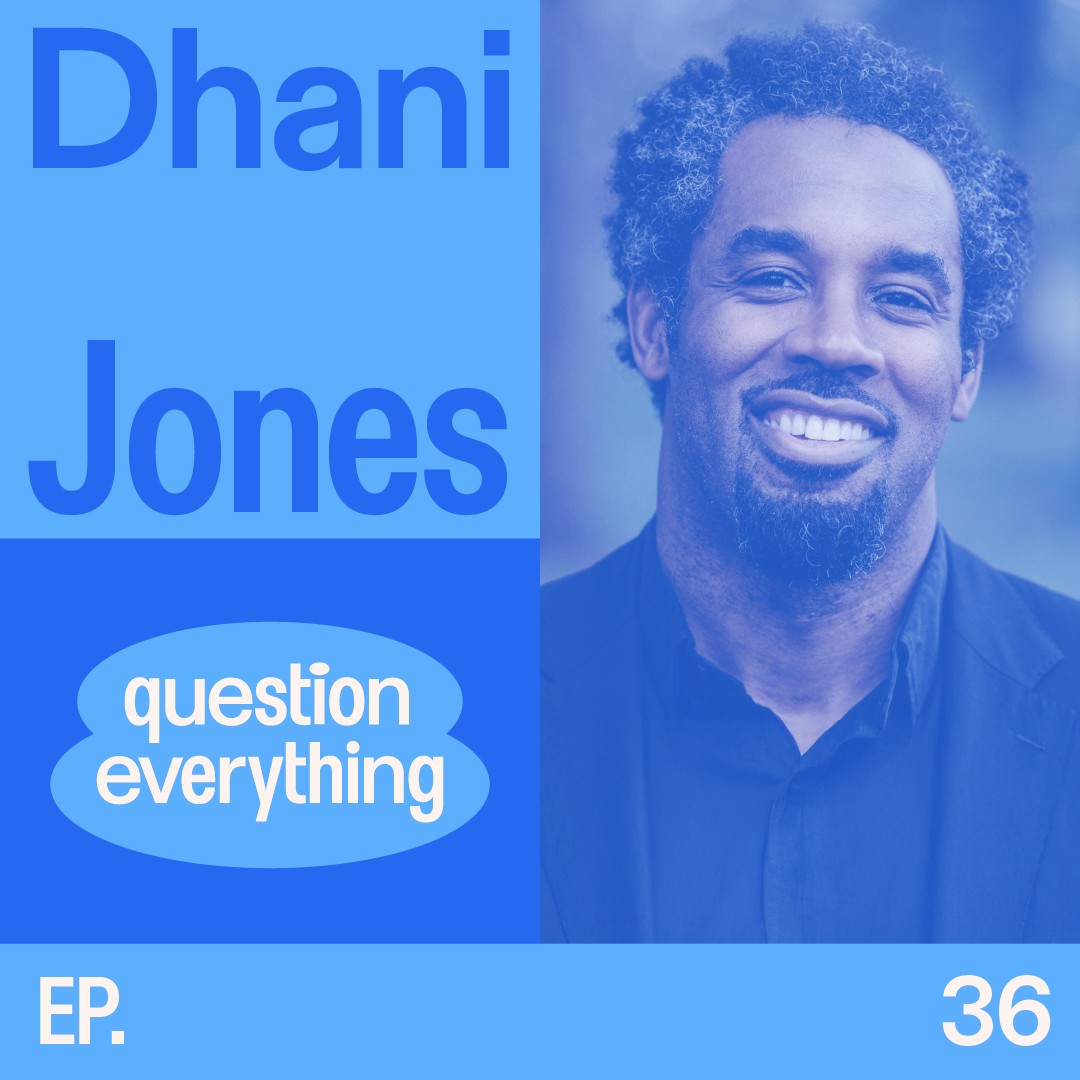
Dhani Jones is a former NFL linebacker turned entrepreneur, investor, business strategist, and reality TV host. After spending 11 NFL seasons across the Giants, Eagles, and the Cincinnati Bengals, Dhani built a winning career off the field – founding two agencies, a bow-tie-centric nonprofit, and co-founding Key Capital, where he’s locked in on building scalable, purpose-driven businesses. Whether it’s advertising, investing, or tackling the globe, one thing is for sure: Dhani brings the same discipline and curiosity to business that he once brought to the gridiron.






For the Super Bowl edition of Question Everything, we caught up with former NFL linebacker, now investor and entrepreneur, Dhani Jones. After founding two creative agencies, advising several startups, and serving as a board member across multiple categories, Dhani shares what it takes for brands to stand out in today’s increasingly crowded marketing landscape.
In the episode, you’ll hear about Dhani’s journey on and off the field and the lessons he’s carried from the gridiron into the business world. He unpacks the parallels between the locker room and the boardroom, the Super Bowl ads that truly earn attention, and why playing it safe may be the fastest way for a CMO to lose their job.
Learn more about Dhani’s foundation, Bowtie Cause
Thank you. Hello, everyone. Welcome to the Super Bowl edition of Question Everything. This year, we're watching the big game with someone who has done it all. Former Cincinnati Bengal, ad exec, reality TV star, and investor Dhani Jones. On this episode, you'll learn why the boardroom isn't so different from the locker room at halftime. What a Super Bowl. needs to get Dahani's attention, plus a roundup of his all-time favorites. One thing about Tom Brady no one else knows, plus a surprise cameo from a Question Everything Hall of Famer. So break out your jersey and the skyline dip. If you know, you know, this episode is star-studded and full of plays you'll want to implement in 2026. Let's get started.
Learn more about Dhani’s foundation, Bowtie Cause
00:00:56
Dahani Jones is a former NFL linebacker turned TV host, entrepreneur, and business strategist. After spending 11 NFL seasons across the Giants, the Eagles, and the Cincinnati Bengals, Dahani built a winning career off the field, founding two agencies, a bowtie-centric nonprofit, and co-founding Key Capital, where he's locked in on building scalable, purpose-driven businesses. Oh, and he's on the board for Outside Magazine. Whether it's advertising, investing, or tackling the globe, one thing is for sure, Dahani brings the same discipline and curiosity to business that he once brought to the gridiron. Dahani, welcome to Question Everything. How are you? I'm good. I like how you did. The Curiosity. Yeah, I snuck that in. I see how you did it. I like it. I like the style.
00:01:46
I mean, Jeff Warman told me you're one of the most curious people he's ever met. Is that true? Did he also tell you how I stalked him going down the highway like 90 miles an hour to try to figure out how to convince him to like, you know, think about different ideas? Bye. Bye. He didn't, but I'll ask him tonight. He didn't tell you that? No. Why is he leaving stories out? He needs to tell you the entire, the complete story. But I'll let him do that. Okay, that'll be for dinner tonight. So what's going on? New in your life? Any new TV shows coming out? No. You know? I've just been doing a lot of traveling. I'm always obsessed with traveling to the next country. I'm always obsessed with meeting the next person.
00:02:27
I'm always obsessed with like the next business idea. You know, I just feel like my brain sometimes it's just like high school, college, a professional track meet. And I've just got these ideas like ripping around my head all the time. But I'm honestly, a couple of days ago, I was in Boca, Florida, doing a TV show with Entrepreneur Magazine called Elevator Pitch. Which is, you know, it's three entrepreneurs that are investors, and it's people with these amazing ideas that are pitching for one of us to be an investor in their business. And so it's always fun to just like think about where people start and the possibility of it all and ultimately like why they got to the point of curiosity where they decided to kind of take the leap, and so it's exciting for me. Fun, I can't wait we're gonna unpack all of that today. So you kind of know how this show works I have 12 super spicy questions, Jeff may or may not have helped write some of these
Learn more about Dhani’s foundation, Bowtie Cause
00:03:28
But you don't know what's behind any of these numbers, right? No. One, two, three, four. 6 '7. 6 '7". Or I can go back to 4 '1, 4 '1. You know, all these different numbers phenomena, I'm just going to make another one. 12. Is that how we do it? Let's just start off. 12.. All right, let's go. So I heard a story. You convinced the University of Michigan to allow you to create your own major. What? Why? How? What happened here? It's funny and at the same time ironic that this question came up because one of the other things that I just left a couple days ago was my high school football coach's funeral. And uh, He was an amazing guy, and he always would challenge me.
00:04:17
But he also sometimes questioned if something, if I could, if I could do something and I think he thought that was motivation for me, and I think in a lot of ways it was, and you know, Coach Shepherd. But I would say, you know, you're a little bit undersized. You sure you're going to play linebacker? You know, you're you're decent speed, but you need to get a little bit faster if you want to play in the NFL. One of the things one of the other coaches reminded me at the memorial, he said, 'You never thought about a ceiling, Dahani.' You never thought that the ceiling really existed. And soI had to convince the University of Michigan to give me the major that didn't really exist. Why? Because.
00:05:03
Why not? Why not? You know, the idea that I had was I wanted to learn a little bit more about who I was or who I might become or who. I am at the moment because I think a lot of times you go into college and you're expected to be somebody, and you kind of evolve through these different classes, but there's no class around evolving around yourself. And so, when I got to Michigan, I designed my own major called self-representation, and I basically assembled all these different opportunities for me to sort of stretch my imagination and really push beyond this wall that my coach, Fred Shepard, said that I knew never existed. And, you know, I took everything from sewing and baking to creative design. You know? Chemistry.
00:05:54
I just kind of put this on a bucket and to see how I would respond. I think it's really important to kind of stretch the imagination and utilize a certain level of elasticity as a person to really understand what what boundaries are artificial and what ones are actually real. Because most of the time, most people don't go to the very edge. People are very comfortable staying on the highway. Has anybody else taken up this major? Do you know? No. No. Come on now. It's Dhani's major. It's Dhani's major. That's great. You need a scholarship for it or something. Michigan's already got a lot of money. Yeah, they're good. They're doing good. Are you talking to the athletic department about? A contribution that I've yet to make—no, okay, no.
Learn more about Dhani’s foundation, Bowtie Cause
00:06:47
All right, let's go back to the board. All right, how about number eight? All right, well, speaking of football, tell us, I think our listeners really want to know, what's really happening in the locker room at halftime? So, like, pull us into the locker room at halftime. And then, also, can you draw any similarities between the locker room and maybe the boardroom? Oh, halftime in the locker room. I don't know if you have enough bleeps in your system in order to X out or to remove the language when you first walk into the locker room because it basically is a expletive-fueled, quick 20 minutes get into your mind, get you back settled, and back to stasis moment that every team goes through, whether they're winning or whether they're losing. Right?
00:07:44
It's not about 'keep up the good work, you're doing well.' It's about examining the challenges. That you've had up until this moment. And then figuring out how to fix them, right? The score could be, I don't care, 20 to 7. The score could be 50 to 15. The score could be 30 to 30, right? Everything restarts. At halftime, you go into the third quarter. And hopefully. You've adjusted course and really figured out this measuring stick of who you are, who your competition is. Right? And I. You can think about it in the world of consumer marketing, advertising, storytelling, right? And to be honest, most people don't even get to have time because most brands flame out. Whether they don't have enough cash, or whether they don't have enough cachet.
00:08:35
They don't have enough consumers. They don't have enough culture. They really haven't found their niche. Right? Most brands don't even get to halftime. And even more so. Now halftime. It's just, uh, it's just sort of a fleeting moment because everybody thinks that they've essentially figured it out when in actuality you need a friend or a family or a supporter or a company to sort of illustrate to you where you really stand. So that you know exactly where you're going, and that's what halftime is about, and that's how it's similar to a boardroom, because you know, as I said on the board outside, we're constantly having discussions with the executive committee about where the business is and who we might consider. You know. Hearing differently from us, right? I remember, um, Karla Harris.
00:09:3
Morgan Stanley. You know, icon, right? She would talk all the time. You know, as a board member, you're there for advice and counsel, right? So, just like a coach. Now, a coach might have a little bit more power. I mean, the board has power, but the coach might have a little bit more power because, if it's your head coach, well, you could be out of there just as much as you might have more of an opportunity. But she would always talk about giving the best advice and counsel, and really listen. Um, really listen to the people that are around you in order to kind of give them a better direction about where they need to go and what they ultimately need to do. And that's the halftime.
00:10:09
Halftime is my coach up on the board, drawing X's and O's, asking Dhani, like, 'Why the fuck were you there?' You need to go to this spot. You should have been there. And then, if I decide, because I might be so bold. But coach, I saw this. You better have a good explanation. And so, just like a CEO in a boardroom, a CFO, CDO, whatever, all these just chief executive and executive managing directors, you need to be surrounded by the right team that's going to give you the right feedback so that, ultimately, on the next play, you go out there and you make it, and you win. Yeah, it's a bit of like a look in the mirror, you know.
00:10:45
Where you've been, where you need to go, and then you have to have that— cabinet of people to give you. It's like the cameras. The cameras are evaluating you, right? Like, you know, I'm evaluating you. Everybody's evaluating you. You know, it's like the cameras you don't see, the cameras you do see. It's like the people around you. Everybody's evaluating. And, you know, I think one of the things I wrestle with. Is that some people don't like to be evaluated. Yeah, that is very true. That's a challenge. That is a challenge. Because if people are really – If there were no mirrors, would you know what you look like? No. Well. How would you know what you look like? How? I'd have to ask. You'd have to ask somebody.
00:11:25
But now we're comfortable with mirrors, so we already can tell ourselves what we look like. Now, sure, you could say, 'Oh, it's a reflection in the calm, placid water and the lake around the corner.' Fine. Okay, I get it. I get it. It's the morning dew against my fingertips. I can see my reflections. Fine. But if you didn't have these tools of reflection, you'd have to ask somebody. And then you'd be forced to either believe that one person, because that's who you know, like, and trust. Or you'd have to really bring an aggregate pool of people and really start to process this feedback to give you some knowledge about where or who you are as a person— one quick story, like when my dad. When I turned 13, Well, I'll say this.
00:12:13
Each year from like when I was eight years old up to 13, my dad would take me different places on my birthday. And he would basically tell me about myself. Mmm. Right? And I remember very specifically when I was 13, he was like, 'Look, I don't think you understand the direction you're going. I don't think you understand.' Sort of the damage that you're doing and the way that you communicate. It was really like a dark direction now, whether I thought I was going that way or not, it was more about my father's interpretation of where he thought I was going, and that was really like a really momentous, but at the same time, life-changing moment where I had to decide. And I think in a similar fashion in the boardroom, much like the locker room.
00:12:58
During the halftime, you have to decide whether you want to believe it or not. People always say, you know, like God will keep throwing all these different things at you. It's not like he doesn't care about you. He's sending these messages to you. You got to decide whether you want to take the boat because you're sitting on top of the house and you swear God is coming to, you know, he'll save you, right? Get in the boat. Get in the boat. All right. Most brands, most people don't get into the book. Most brands, most people, they ignore what people are saying. Sometimes. You'll be right. Yeah. And that's fair. Just as well.
00:13:37
But don't be upset if things don't go the right way, and those who have known, liked, and trusted you gave you the advice and you decided not to take it. Yeah. We say here all the time, feedback is a gift. Kelly Leonard, he was on the show. He's the creative director over at Second City. He worked with Tina Fey, Steve Carell. They have a running philosophy that feedback is a gift. And without it, improv dies, basically. Now, you can also take those gifts and just throw it in the recycling bin. Right, that's right. But, you know, at least receive the gift. Receive it. Receive the gift. And give it like a gift, right? Right. Yeah. If the intentions are good on both sides, it can be life-changing.
00:14:15
So, with the story of your dad, like what happened? Did you take it to heart? Did you make changes or was it like? No, I don't believe that. Made changes, refocused, ended up at the greatest university in the world. And, you know, the rest is history. I might do that with my daughters. I got to figure out where I'm going to take them, but I like that idea. With my dad, it was like 3:30 in the morning, so I was really tired and went to school the next day. That was key. That's probably key. Yeah, okay, dad, whatever. Yeah, yeah, keep talking. Yeah. Okay. I like that. I mean, my 10-year-old will say to me, 'Mom, can you give me feedback on that?' And I'm like, 'I love it so much.' I don't think, at that young age, you're really looking for it.
Learn more about Dhani’s foundation, Bowtie Cause
00:14:53
Your child asks you for feedback. Yeah. Yeah. Wow. I mean, it's been a learned skill. My kids look at me and say, 'six seven six seven all right let's go back to the board. Might as well go to the best one. Number one. Number one. All right. So you started two creative agencies. Tell us what drew you to the advertising and creative space after the NFL. There's a couple different reasons I was drawn to advertising and creative space. I think on the one side, it was, it still is, it's been sort of like a passion of mine. I've never really seen straight lines. You know, there are no straight lines in nature. I'm trying to think of one. There are no straight lines in nature. None. I believe you.
00:15:46
Straight edges. Straight lines. There's none. Trees. Rocks. Sea, sand, sky, clouds, leaves, pick them. There are no straight lines, right? So inherently, even if you think about your children at a young age, what do they all want to be? They all want to be artists. We refine and define and sculpt our kids and our people to be these straight lines. Like creativity. Is really at the core of who we are as people. As individuals, as collectives, as a society, as a community. And so, as an athlete. We're kind of forced into this bucket of just being a player too. When. For me. Stripping away that space of like, what box I'm supposed to go into, was sort of my creative expression of playing the game and to be able to realize that.
00:16:45
In a business and help other marketers, help other influencers, help other brands and people realize and see outside of the space that's just a great and wonderful place for me to find flexibility even in the world and the game of which I play. So that's why creative was and is and has always been sort of a piece of who I am. I mean, I even loved hearing that you wanted to be an art major in some capacity in college. Well, I did art in college, too. I mean, my my final year project in my major is called self-representation. My final project, I did a happening. And happening, I basically had my head coach. I had most of my teachers. I had some administrators from school. I had those that were in heads.
00:17:39
I don't know. Was Damaune in that? No. Maybe he was. There's a lot of people in the school that were all a part of it. My parents were in it. I mean, it's crazy. But my happening. And my play was sort of a creative expression of how my brain works. And so there was stuff happening on the stage and in the audience and in the back room. Up in the Balcony, I mean, there was stuff happening all over the place. And it's interesting to this day, some of the people that were in that room and where they are, what they're doing. Amazing. Phenomenal. I'm just like, I mean, it's more of a testament to the University of Michigan more so than anything else. But just like amazing concentration of talent in that.
00:18:24
in that one room um but i also you know i i just also look upon I also look upon that moment of creativity. As just who I am. And, from that senior project to be able to to be the co-founder of creative agencies is just, I think it's just like. I mean, even though it may not have seemed like a natural progression to me in real time. By divine appointment, it occurred. I mean, and I love, I mean, obviously, I work with Jeff Horman. He's one of the partners here. And you and Jeff were partners in Proclamation, one of your agencies. And I love how you translated. Some of your football relationships into advertising. I know Jeff would be like, 'Yeah, I'm up at Under Armour and you worked with the Muhammad Ali Foundation and Livestrong and like really, really.' Really incredible purpose-driven meaningful work you guys were doing, I think that's really cool and, to be honest, it was really at the edge of
00:19:29
what people, you know, before, before Proclamation, this is one of my challenges in life. I'm oftentimes early. Yeah. That's the problem. Now some would say it's a gift. Thank you. But someone say it's a gift, but sometimes if you're early and you're right, you're still wrong. But Tom's shoes. Bomber socks. Bowtie. Cause you can go down the line in terms of so many of these different brands that have a certain level of cause behind it. And. They were at a sort of a unique turning point when brands started to recognize that people actually were starting to develop a certain level of consciousness around. What? Products actually were. I mean, thank you. What's amazing is, like, Ben and Jerry's never talked about their cause. Right. Okay, Patagonia never talked about their cause.
00:20:39
Right now, maybe there was a stigma associated with the cause and was more just like, we just came to work, and if you talked about it, people would just like shut you down because they just wanted to hear what the product is. But then we kind of came through this phase, where proclamation was a part of, where we started talking about the value of the brand, the consumer, and the relationship between that person, whatever that might be. Now, you know, we're thinking about, okay. What is the environmental impact of such and such? How does it affect us health-wise with such and such? Whether you're talking about a vitamin company, whether you're talking about a car company, whether you're talking about a food company, whether you're talking about an electronics company.
00:21:26
I mean, do you remember when I don't know if people probably remember it, but remember when headphones got shut down for talking about like radiation. Now we all have headphones. We don't even talk to it. You know what I mean? It's like crazy, right? So, you know, maybe that moment helped refine and define the product so that it didn't have so much an impact on your health. And now the headphones that we use now are that much better, right? So there is a positive. There's a positive interaction between understanding the real value of what you're creating and its relationship between you and whether it be the environment or whatever, because the most important thing is to inform the audience and to inform the consumer about what they're buying into.
00:22:26
And as a marketer, that's what you want. You buy this ice cream. Not only because it tastes good but also because of what it represents. You buy this piece of clothing. Not only because of you know where it came from and you want to support that, but also how it makes you feel. You buy these pair of shoes. You buy this watch. You buy this piece of jewelry. You buy this hair product. You buy whatever. You buy this bedding. You buy this bed. Because not only is it going to give you great night's rest, but you know that. Maybe somebody else got another mattress too, right? So we were at that critical point in time, and I think we were early, but even now as I see through curiosity and as I see through not only agencies but also see through brands.
00:23:12
People are not afraid anymore to kind of talk about the things that they're passionate about, the reason why they created the business, because at the core of it all, it's about a human-centric storytelling opportunity. That's how you get committed consumers to stick with your product for the lifetime. That's how you make it through the halftime. That's right. Okay.
Learn more about Dhani’s foundation, Bowtie Cause
We have a little halftime report here that we've got to do. What is this? We've got a guest who has flown in all the way from LA. Who has been a guest on this show and I hear maybe speaking of Michigan, you went to school with him, Damaune Journey is in the house and he's got a question for you all right. All right, I love these setups. I love these setups.
00:24:03
Go blue. Go blue. Good to see you, Dhani. It's a halftime show, so I came to ask you some questions. This guy and I go back, I don't know, almost 30 years. Oh, man. He was a big man on campus. I was a little guy. Just trying to get through the great University of Michigan. And you started an organization. As you recall, Hmm? That led to our introduction. Tell us about heads. Man, this is hilarious. Some people know I wanted to become a pediatric neuroplastic surgeon. Mm hmm. I wanted to become an artist. I knew I couldn't become an artist, but I thought that there was something really amazing about how one would take care of young kids when they were conjoined as young people. And Dr.
00:24:55
Ben Carson wrote this book called Gifted Hands, which is interesting. Other intersections— because of Michigan, totally absolutely right from Detroit— he's like, maybe. But his nephew, his nephew was in school with us, absolutely, which is crazy. And he was in HEADS, exactly right. So I wanted to become this pediatric neuroplastic surgeon, and I went to go see him speak. Now, he spoke at Eastern Michigan University. And I just remember him talking, illustrating how the neural synaptic, neurological, or neurosynaptic fibers allow your hands to communicate. You know, your hands can tell you when you've touched something. I just remember this this whole moment. And I just was thinking about how people, through connectivity, and through touch, and through interaction, oftentimes don't get those moments to really spend in deep thought and consideration with one another.
00:25:53
And so after hearing him speak, I was caught up. Couple folks on Michigan's campus. I was like, you know what? The black male experience on Michigan's campus is about as separated as one can be. That's right. All right. I'm an East Quad. Sure. I got a couple of brothers that are in East Quad, you know, North Campus, Engineers, right? You know, West Quad, South Quad, you know, people are over. Mark. in different places and you know, you see people in the fall and then winter time it's cold outside, okay, okay, keep it moving. January, it was cold. February, it's cold. March is cold. The first day of spring, woo, everybody's out. Everybody's out. And then everybody scatters, right? Because everybody's trying to find their space. Yeah.
00:26:47
And so HEADS was a great opportunity for all of us to come together, and it was just really built around the principle of that neurosynaptic interaction. Black men being able to have conversations with one another, to be able to experience. the University of Michigan atmosphere together. by not being apart, but discussing. books and by having high level discussions about the challenges that we faced on campus and you know it's interesting even to this day it still exists it's like one largest black male organizations on campus and people are still having conversations every monday night see we're like hanging out and that's how that's how heads came to exist and how it ultimately led to our connection but then so many other of our friends on michigan's campus Exactly. It's interesting.
00:27:39
HEADS stands for here, earning a destiny with honesty, eagerness, and determination of self. That's right. And almost 30 years later, I remember that we didn't know each other. You were a big-time athlete. I was an engineer stuck on North Campus, but I helped to run or helped to run the National Society of Black Engineers. Wow! And so, through Nesby, which is the largest student-run organization in the country, you got connected to me somehow and said, 'Hey, you guys have a structure around your bylaws and constitution.' You've built something that's lasted for at that time— 25 years. How do we institutionalize something like heads? What can you bring to the table to help us learn? And so it was the first time I ever felt like a consultant.
00:28:26
About building a thing on campus that can last for some time. But we knew it wasn't for me and your organization. It wasn't for you, but it was for the collective. Exactly. And for those behind us. Yeah. I mean, it's like 25 years before that, even 25 years up until now. HEADS being around for almost 25 years, it's just amazing the duration and the legacy and the discussions. Well, you know, you played so many games, you played first halves. She played second halves. She played overtimes, both for the great University of Michigan and the Bengals and other cool places. But rarely have you been a part of a halftime show. And I just want to say thank you. I'm happy to be your first halftime show.
Learn more about Dhani’s foundation, Bowtie Cause
00:29:10
And I'll turn the mic back over to the main event. Thanks, brother. Good to see you. That's awesome. All right, let's go back to the board. Where do you want to go? Let's go to 11. 11. All right, so I was told that you were arrested in Miami for dancing in the street. No, I was detained. I was just detained. I was just detained. I was just detained. The copywriter in Jeff said 'arrested.' So my take on this, you're obviously down to take some risks. Has there been a risk in your life after you defend yourself clearly? That's paid off. I mean, in my mind, you were handcuffed and taken to the Miami prison. Oh, wow. Thank God for the internet or else maybe we'd forget some things. Thank you.
00:30:07
Uh, risks. Yeah, what is life without risk? It's just uh, hanging around in a padded room with you know, socks and t-shirt with no windows. Boring, boring, yeah, it's not life, right? Everything is a risk. Every moment is a risk. Every time you drive, fly, talk, every time you open your mouth, it's a risk. Yeah, you know, every discussion you have, every dinner that you have, every idea that you put out there, every idea that you don't put out there. Everything is a risk. All the children that you have, all the loves that you have, and all the loves that you lost. It's all a risk. I mean, life is but a risk. So I would say that, you know, we're surrounded by it. If you don't take them, then you really haven't lived.
00:30:57
So I can outline a dozen of risks that I've taken both on and off the field and businesses that I've. You know, put capital with or not. and money that I've made or money that I've lost, but you know, they're all essentially worth it, because they sort of frame and contextualize the moment of which I sit, and you know, you're reminded every day about the things that you've done, but also more importantly, the things you haven't done. What do you say to a CMO who's afraid to take a risk? You need to get a new job. Any CMO that won't take a risk. I mean, you might as well be at a 150-year-old brand that hasn't done anything different. So, I mean, that's fine. You just might be okay making white sheets of paper.
00:31:46
But you're really not going to be remembered for anything because you never took a chance. I mean, even parchment has been innovated upon. OK, right. So, like blue lines, red lines, you know, little flakes of like pulp from, you know, poplar trees versus pine trees. OK, you know, you can take chances even in a boring business just as much you can take. You know chances in a vitamin company as much as you can take in a watch company or a CPG, but it doesn't matter if you don't have the ability to take a chance as a CMO, then you're really not a marketer. Marketers take chances. Marketers see something from a different perspective that they believe is needed otherwise they just might as well just Throw the job title away.
00:32:35
You know, like if you're marketing a company, you're doing the same thing that you're not really a marketer. You're just a placeholder. Yeah. Right? You're a Chief Placeholder Operator. Okay? Nothing. If you're a CMO and you're marketing, you got to figure out what your market is. And if you already have that market, sure. Hold on to that market. Go get new market share as a. As a stockholder in a business, I don't want someone that's just all of a sudden just like okay with status quo. Yeah. You can. Also, say, well, I don't wanna take that risk. Wow. That's just about as banal as that. White sheet of paper that you're scribbling on right now, taking these notes. Thank you. Great advice. Just saying. Just saying. 4 '1. Yeah. 4 '1. All right.
Learn more about Dhani’s foundation, Bowtie Cause
00:33:23
All right. Let's go back to the board. Okay, how about number? How about nine? Nine. Well, that's my favorite number. All right. So you've played. Oh, this is funny. You've played with him. You've played against him. What can you tell us? Anything that we don't know about Tom Brady? I mean, his whole life is public. There's nothing you don't know about the guy. I will tell you one thing about Tom Brady, but also as it relates to me, which is interesting. No, actually, no, that's not true. Let's see. One thing people don't know about Tom Brady? You know, I would reframe it and say one thing that probably people don't realize about Tom Brady. Tom Brady. As competitive as he seems. Tom Brady, no matter how high he gets,
00:34:13
He's still got a chip on his shoulder and he feels as though he's not that high. He's always working on himself. He's always pushing himself. He's always taking the feedback from those that are around him. He's always investing in himself. He's always looking to find ways of being uncomfortable, as to sort of developing a better comfort and where he would like to be, even though he's never comfortable in where he is, because he's always trying to figure out how to become better and get himself out of that uncomfortableness into the comfort, right? So he's always working. I think. When people reach a certain level of superstardom, or even you could talk about a brand reaching a certain level of superstardom. And I was, I remember.
00:35:06
Tom and I's coach, Lloyd Carr, and coach Carr would always talk about the story about Wally Pipp. Wally Pipp, um, was a baseball player and Wally Pipp, you know, I forgot. I'm trying to remember who the baseball player is that ultimately took his job because Wally Pipp was just feeling too good about himself, right? Who is it? Who's Wally? Someone look it up. Right. Somebody. A fact checker. Lou Gehrig. I think it's Lou Gehrig. I think it's Lou Gehrig. Right. So like. Wally Pip just. got complacent. Got complacent. Right? Got comfortable. And then Wally Pipp got his job taken. Right. So think about all the different people, situations where. You feel. Comfortable. You know, you can even quote from like Wakanda, right? Y'all real comfortable up there on your chairs, you know, like feeling good about yourself, right?
00:36:08
And so Tom is a kind of guy that never really wants to feel comfortable. So he's always pushing himself. And then pressing the ceiling and pushing the limits and going to the outer edges to keep you know by the way I said that. While we're growing, we need to be able to find our edges. Doesn't mean that the edges are finite. Mm hmm. Doesn't mean those edges are 90 degrees. Doesn't mean those edges are shaped down or shaped up. Right. Imagine if the edge is shaped up. You can sort of keep climbing. You might find yourself slipping back, and then you might go over the edge. There might be more edge because that edge might be rippled. So there's a lot of different ways that people look at edges.
00:36:54
They might say, well, edge is just a box. I saw this. Discussion about how an ant or spider or something like that. You can draw a circle around it with a black marker. Have you seen this? No. And they won't go outside the lines. Thank you. Even though it's on a piece of paper, even though the piece of paper is on a table and even that table doesn't have any legs, it's just on the ground. And, you know, on the ground is. Think about it. Yeah. Right. So we create our own. Same thing in marketing. We create our own edges. Yeah. And sometimes people put a circle around it. As a marketer, your job is to remove the circle, to remove the paper, remove the table. And make it. Infinite. Yeah.
00:37:34
I love the thought, too, about not getting too comfortable. I mean, we work with a lot of challenger brands. That's kind of our sweet spot. And we talk a lot about waking the sleeping giants because I do think a lot of brands can get really comfortable having sat at that number one spot for so long. They don't, they feel like they don't have to innovate. They don't have to do anything differently because they've been sitting there forever. Go to the S and P, go to the NASDAQ. Go to the Dow and I'll show you the businesses over the last 30 years who got comfortable and who died. That's right. That's right. All right, I'm gonna call an audible. Uh, we're gonna do a little uh uh overtime question if you will.
Learn more about Dhani’s foundation, Bowtie Cause
00:38:13
Okay, I'm gonna pick one. If you're cool, we're not going for a tie. Are we? We're not going for a tie. No, this is for the win. Okay, go. All right, all right. Number seven. All right, so you know, the Super Bowl is the, I would say, like the pinnacle of advertising, right? Advertising agencies really bring their best work forward during the Super Bowl. So I'm curious, one, do you watch Super Bowl ads? And then two, what's your advice to brands and agencies on what makes a Super Bowl ad great? That's a tough question because you're on a stage of which billions of people are much like these cameras, just evaluating every single pixel. Every word they're not— they're not just examining you know one you know. One eye.
00:39:04
They're looking at your entire facial structures and hair and earrings. Like they're looking at my shirt, and they're looking at my glasses, and they're looking at everything. So it is the single solitary moment of which you can make or break your business. Period. That's the Super Bowl ad. It is one of the greatest opportunities to make a mark or to be marked off. You know, it's interesting over the last couple years and I watched the Super Bowl. Every year I watch the ads before they come out. And I love conversing with my friends about ones that are really good and ones that are not. But it's a place to really make a statement. And I wonder, in this day and age, when people have a short memory. How long people do recall.
00:39:59
Certain things, and if that mark is dry erase or if it's actually permanent. Thank you. But if you have an opportunity and you have a budget to do so, you better get the best agency to just come up with some amazing, um, copy. That people will remember for their lifetime. Yeah, is there one that like has stuck with you for a long time? I don't know if there's one in particular that stuck with me. I can't remember which car company. Did one maybe with Buzz Aldrin and he was driving. I think that was amazing. I tend to like the ones that really allow me to recall something. I think there is. Maybe a toothpaste company that did something about water. I think that was really really beautifully done.
00:40:50
There was another father-daughter or mother-daughter competition, you know. I just like the ones that tug on the heartstrings. I mean, I mean, who doesn't like the horses? Okay, we all love the horses, one right. What about the frogs? I mean, that's one of the most one of the most iconic commercials. Um, I don't even think I was old enough to drink when it came out. Yeah, I mean, there's just so many. Then there's ones that you're like, 'Why did you even do that?' That's just such a waste of time. I agree. I watch all the Super Bowl ads. I watch the ones that are just buying time in streaming, ones that are buying time in broadcast. And ones that are just sort of taking advantage of the moment.
00:41:36
And I think that, as a brand. First, you have to decide whether you want to take advantage of that moment. Who and how you're going to live up to the moment. In who and how and what you're going to do to really capitalize on the moment and to be honest, some brands I don't think they're thinking about capitalization— they're just thinking about making a moment that people will not forget. Mm hmm. My favorite. Halftime commercial is not a commercial. Thank you. It was when Prince said 'Purple Rain.' And it was raining. Thank you. That's my favorite, hands down. And in my book, that's one of the greatest performances ever. You have to give some credence to good luck, good fortune, and good timing.
Learn more about Dhani’s foundation, Bowtie Cause
00:42:28
But also give deference to those that have had amazing experiences that just want to be able to express themselves, because in truth, as humans, we'll believe you. Well, speaking of great performances, this was a great performance. Did you have fun? Great time, all right. So we always end our podcast with a little 'this or that Okay. Are you game? Game. Okay, so the first thing that comes to mind, don't overthink it. So I just say this or that? You're going to say six, seven. Okay, ready? Here we go. Football or Lucha Libre? Football. Even though I'd love to own Lucha Libre. All right, let's go. Investing or advising? Golly, investing. Playing or commentating? Playing. Okay, a self-tie or a pre-tied bow tie? Self-tie? Self-tie. Always self-tie. All right, Jeff Warman or Courtney Franke? Without Courtney, there would be no Jeff. That is so true. Courtney. Uh. Courtney. All right, Dhani tackles the globe or a ton of cash. tackles the globe, all right, my friend. This was amazing. Thank you, thanks for coming on the show.

Chief Development Officer and Host
Lorem ipsum dolor sit amet, consectetur adipiscing elit. Etiam eget nisl sagittis, efficitur felis malesuada, egestas velit. Fusce vestibulum porttitor tellus ac facilisis. Duis aliquam tellus sed est aliquam tincidunt. Pellentesque bibendum mauris ut finibus sodales. Cras tempus tempus posuere.

Lead Guitarist
Lorem ipsum dolor sit amet, consectetur adipiscing elit. Etiam eget nisl sagittis, efficitur felis malesuada, egestas velit. Fusce vestibulum porttitor tellus ac facilisis. Duis aliquam tellus sed est aliquam tincidunt. Pellentesque bibendum mauris ut finibus sodales. Cras tempus tempus posuere.



.png)


