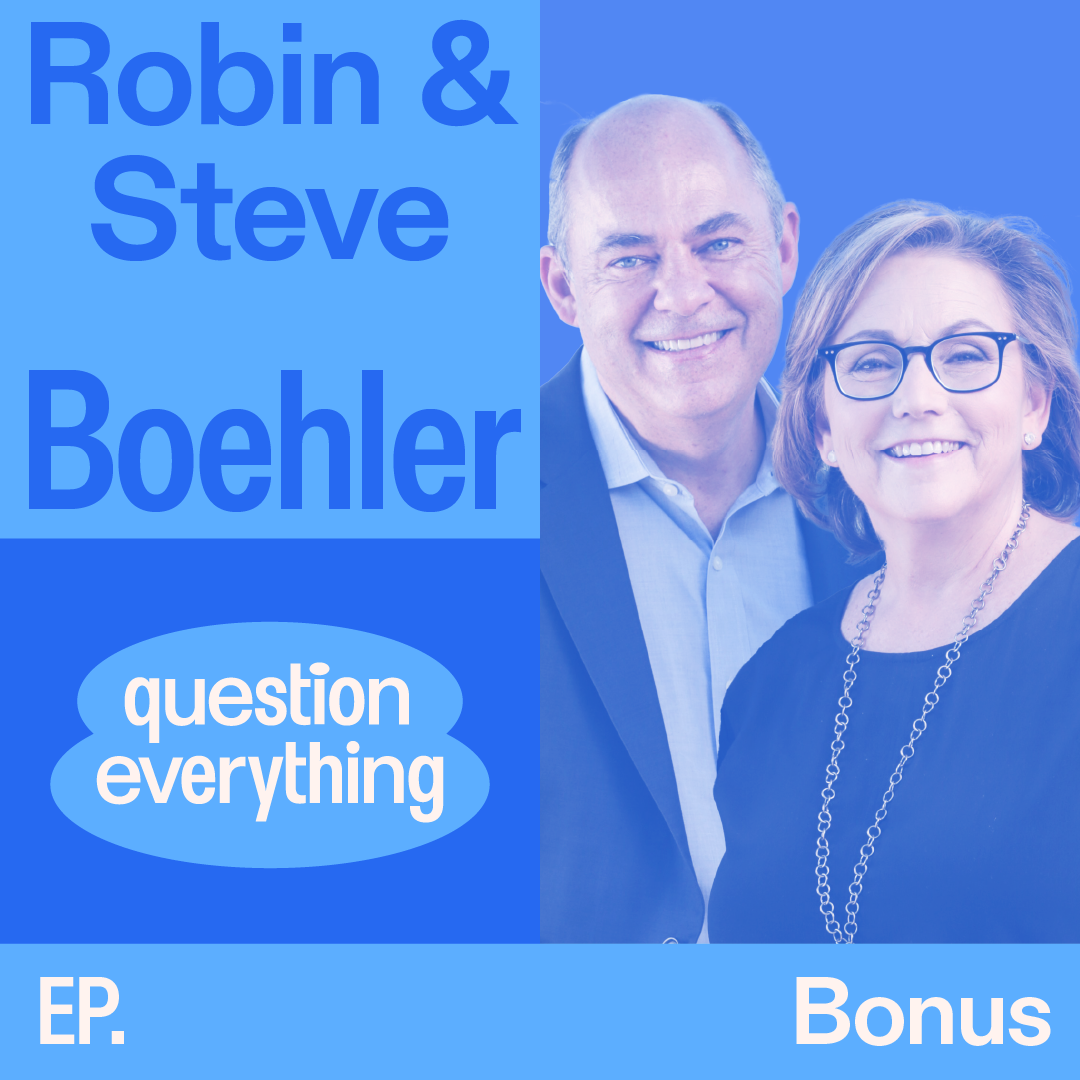
Robin and Steve Boehler are the powerhouse duo behind Mercer Island Group, one of the West Coast’s top marketing consulting firms. They’ve just dropped their new book, It’s Not About You: Winning New Business In A Crowded Agency World – an agency must-have, breaking down how to go about and ace the complex pitch process. Find out what really matters to prospects.






Robin and Steve Boehler have seen the good, bad, and ugly in countless pitches for culture-shaping brands like Starbucks, Microsoft, Abbott, and Nintendo. Lucky for us, they wrote a book on how agencies can shift the pitch spotlight from core capabilities and humble brags to solving your prospect’s problems. Cause that’s how you win.
In this episode of Question Everything, we cover major insights every agency needs to hear from the Boehlers’ new book, It’s Not About You: Winning New Business In A Crowded Agency World. You’ll learn what a prospect-friendly pitch looks like, how to get to the root of a prospect’s problem quickly, and how to seal the deal before leaving the boardroom.
Get a copy of It’s not about you: Winning New Business In A Crowded Agency World
00:00:00
Thank you. Thank you. Hello, everyone. Welcome to a bonus episode of Question Everything. This week, we're unpacking Robin and Steve Bowler's new book, It's Not About You, the prospect-friendly pitch. On this episode, you'll learn the five slides that all successful pitches have. How most agencies lose the pitch before it even starts, the delicate art of scope negotiations, and Steven Robbins' new business predictions for 2026. Spoiler alert, there's good news on the horizon, especially if you're an indie agency. If you're ready to reinvent your agency's new business engine, this episode is for you. But remember, it's not about you. Let's get started.
Get a copy of It’s not about you: Winning New Business In A Crowded Agency World
00:00:48
Robin and Steve Bowler are the powerhouse duo behind Mercer Island Group, one of the top marketing consulting firms on the West Coast. Experts in strategy, organizational effects, and client agency relationships, they've led huge marketing efforts for culture-shaping brands like Starbucks, Microsoft, Abbott, and Nintendo. In addition to leading hundreds of agency searches, they've just dropped their new book, 'It's Not About You,' the prospect-friendly pitch. And today, they are here to spill the juiciest bits exclusively for our Question Everything audience. Stephen Robin, welcome to the show. Thank you for having us. Great to be here. Absolutely. Now, you're actually a return guest. You've been on the show before. We have. We're guests. We're very lucky. Which I love. Okay, so you've just written a book. Tell me a little bit about it.
00:01:39
Why? What's it about? Why now? Yeah, we wrote a book. What it is essentially is a field guide, I guess is a good way to describe it, for agencies to— think about new business based on true, real-life stories that we have experienced doing reviews for decades and working with agencies to help them figure out. Where should they focus? How should they talk to clients? What do clients care about? What do prospects care about? And so that was the impetus of this was that people have asked that. Well, first of all, people tell us all the time, you should write a book. You should write a book after we do workshops. So we kind of cobbled together all the different things that we teach and all the different things that we've learned into what we hope will be a good field guide for agencies, something that they can have on a shelf.
00:02:36
Take off the shelf a lot. For very practical suggestions. Yeah, so I got an early read of the book. And as I was reading it, it was a trip down memory lane for me because I've been to many of these workshops. Many of them happened in Orlando, where I first met the both of you many, many years ago, early in my BD career. And that's exactly what your workshops did for me in those early days. You gave me a blueprint. And I remember taking it back to the office and just doing everything you said an agency should do. And holy crap, like it works. I am living. Proof I've actually done it at two agencies now, following that blueprint.
00:03:19
And so, having it all in one place, especially with some of those real-life stories from some amazing, amazing agencies who have also done a lot of this, it's just incredible advice, but it's very very practical, which I really appreciate. This is a special episode. I have six questions on our game board. You do not know what questions these are. So it'll be a little improv fun. But as you know, the power is in your hands.
Get a copy of It’s not about you: Winning New Business In A Crowded Agency World
What number do you want to go to first? Okay, I'll go with number three. Okay. Number three. So let's talk about the five-slide concept. And also, if you could ban one slide from an agency pitch deck forever, what would that be? And is there anything that you think should replace it? All right.
00:04:07
So I love this question because we arrived at this five-slide concept by working really closely with one of the greatest sales trainers in the world. This guy had trained Microsoft and Verizon and giant, giant sales organizations on how to sell by getting people engaged, how to listen, how to ask the right questions. And one of the things that we learned from him was that most sales presentations are all about the seller. And this fits so well for us because most agency presentations are all about the agency. So the key to the five slides is that it caps the amount of territory, the amount of geography in your pitch that you can give to the agency itself.
00:04:54
and forces if you really live by the five slides that forces you to spend the vast majority of your discussion your presentation about them, because it's not about you, it is about your prospect, your hopeful client, etc. And if there's. For me, if there's a slide that should be banned from agency pitch decks, it's a sixth slide about the agency. Just stop. Yes, I don't care what it is, if there's a sixth slide that is absolutely one slide too many, I love that. Robin, what do you think? The five slides give also agencies a way to have slides that they don't have to change every time. Because so many agencies scramble to start a pitch deck from scratch every single time they're going to talk to a prospect.
00:05:45
And then you're just making the work. Thank you. Double every single time. You're never taking advantage of work you've done in the past without cutting and pasting. You actually have five slides that live about your agency. That never have to change and it also gives you a very consistent way to talk about your agency. Do you want to talk about what the five slides are? The first slide should be about what makes the agency special. We call it the agency philosophy. Years ago, Goodby talked about art serving capitalism. McCann is truth well told. It's that encapsulation, that brief slogan-like language that makes the agency really special. Say something that's special about itself that really might be endearing or really fascinating or interesting to prospects. The second slide is a process.
00:06:38
It is whatever the agency processes, it should be simple, three to five steps, and it should be able to show how an agency gets from the business challenge, always the business issue, to some fabulous conclusion, but in the agency sort of language that links back somehow gracefully to whatever that philosophy statement is. The third slide. Is it sort of explains in some creative way what it's like to work with the agency. So that you sound really interesting as people. You sound like you're the kind of folks that the client would want to work with. And the last two slides are pretty straightforward. It's a logo slide. This is all those great clients and past clients that you've had that makes it look like you're really a fabulous agency.
00:07:33
And a nice, simple capability slide. And that's it. Yeah, so what many agencies do is they start with those five slides, which is for a client who's looking at four presentations in a day or over two days, Charlie Brown's teacher talking. They're not listening to you then. You don't bond with people over your solutions without any context with their problems. You bond with them over their problems. So we recommend that you start out any pitch that you're going to give talking about the client. Just, if we're talking about a creative pitch as an example, since that would be irrelevant to curiosity, could be media, but let's talk about a creative pitch in this case. Um, you're going to develop a strategy— a strategic approach— and you're going to have an insight we hope a really nice, really juicy insight that helps set the client apart in a way that really meets the needs of the consumer.
00:08:27
And it's true to the brand. And you're going to share that insight after you show all the research that you did to get to that insight. And then you're going to pause. Before you share the creative— the juicy creative, the really fabulous on strategy creative— you're going to pause and you're going to say. Before we share, our solutions are creative. We'd like to put that in context for you because we know you have choices. You can. Obviously, there are other agencies that are interested in this business. We want to make sure that you understand the context within which we develop this work. Then you share your five slides. You come back, you reshare your insight. And onwards you go with the great work that you're going to share.
00:09:05
It sounds so easy when you say it like that, but I will say, like, as an agency owner and someone who's done this, like getting it to five slides, like your natural instinct is, well, no— I have to tell more. I have to tell more so that. editing process is absolutely critical and then where you remember that. In this case, we're talking about when you're in the room, right? So you've already, they already know who you are. Exactly. Your issue wouldn't be in the room. Yeah. So you don't have to tell them again. They don't need to know all the awards you've won. You've probably already submitted that in a written presentation. That's right. So they already know. And if it was important to them, they noticed. And if it wasn't, they didn't.
00:09:41
But now we're talking about them. That's right. That's right. It's a really good advice. And as you're rehearsing your presentations, my suggestion is trying this and inserting that small window of time that you're dedicating to talk about your agency. A little bit closer to the middle after the strategy, but before the creative, it's a nice teaser too. I think you've got them waiting for the creative. You know, they're so excited to see that part. And so that little pause and breath, it's almost a bit of an intermission. But they're really leaned in at that moment as well, I've noticed. All right, awesome. Let's go back to the game board. All right, let's choose this. Sex. So we have a shared passion for questions. I think you guys have a great philosophy on question asking.
Get a copy of It’s not about you: Winning New Business In A Crowded Agency World
00:10:31
Tell me, tell the listeners, what's the secret to really killing that Q &A session? This is a good question. The Q &A session, which often feels like a throwaway to agencies, is not a throwaway. If you get time to talk to the client, and you're not just submitting questions via email, this is a chance to develop some chemistry and to kind of share and show. How strategic you are. So the secret to killing the Q &A is to ask questions about their business. Ask questions about how they think. Ask questions about what strategically matters to them. Don't ask logistical questions about the pitch. Stay high level. But with enough detail for it to be useful to you. So think about the question and answer session as a way to prove.
00:11:24
Prove your own credibility. You have to have done research before you get to the Q &A. Don't ask questions you can easily find. Online. Ask questions around what are your plans for development of new stores would be a much better question. I see that you have 120 stores. Are you thinking of expanding into more territory in the next year or two? That would be a better question than how many stores do you have and how many you're going to open. So try to make those questions more juicy, that show that you've done your homework before you get there. I think also, for agencies, if I'm going to think logistically for how agencies can kill it, how do you set it up? There should be one MC on the agency side.
00:12:08
Who fields the questions and tosses them off. So question comes in, and I'll say, 'Steve, that would be a great one for you to answer.' Some agencies do a very good job of dividing their questions up in advance by discipline. So Ashley is going to go first and she's going to ask questions about the business itself and some strategic questions. And then Steve's going to ask some questions about measurement. etc. etc. That can also work too, just be very diligent, very organized, and make sure that you come in and keep track of your time. So that you don't spend all your time up front because you had 200 questions to bring and you never got to the questions at the bottom of the list, which actually were really important to ask too.
00:12:48
Yeah, I think that's good advice. You also offer up a framework in the book that's above and beyond the Q &A and really thinking about pre-Q&A questions and what can you submit to the consultant or if you're working directly with the brand and then what is going to be back. for that face-to-face Q&A. And then post Q &A as you're leading into the tissue, following the tissue, if you advance to the finals. I remember one time you told me in a pitch that we were successful in that we were the only agency to ask questions as it got close to that final presentation. And that was so shocking to me. Yeah, a lot of agencies don't ask.
00:13:28
So there are a couple of really important points within the process where I'm kind of surprised agencies don't take more advantage of question asking, especially when you've got a consultant running the pitch. So first of all, when you get that RF. p request the very first request I can tell you that we've just launched a couple of reviews and of 10 agencies receiving an RFP, maybe two. asked questions say hey can we hop on the phone we've got a few questions Two. That means eight did not. So it- If you don't have any, I'm going to wonder why you don't have any questions about it. And if you don't ask them, I'm going to wonder, why didn't you think that we can help you? That's what we're here for.
00:14:09
We're here to help the client make the best decision, which means we want the agencies to show their very best. The other time that is really shocking to me is when agencies don't ask questions, which is what you just mentioned, Ashley. And that is after that tissue session, after you've had a chance to meet with the client. Even if we've given you feedback, now you're getting down to the wire and you're about to show up. And I'm sure you're reaching many forks in the road. Should we go left? Should we go right? Should we do this? Should we do that? Why don't you ask for help? Ask for feedback. Check in with the consultant and say, 'Hey, we're debating whether we should lean in heavily on AI or just mention it as a tool we use.' As we talk about this one thing.
00:14:50
We just had an agency that did that, and it was really smart, and I think it made a big difference in what he submitted. Yeah, I think there was a very pivotal point for me in my career when I would think of a search consultant as like a gatekeeper versus an ally. And you are really there— to support the agency and the brand to get to the best possible outcome and relationship at the end of this. And I think, if agencies can reframe how they think about consultants and lean in and work with consultants, you can be so much more successful. I actually prefer reviews that have a consultant in them because you get so much more access and visibility. I mean, you've been working with these brands for a couple of months before the RFP even goes out.
00:15:34
So you know them. You've sat with them. You have a lot of retained knowledge that's probably not even in that RFP that you're allowed to share. Right. And our philosophy is that we want the client to see the best of the agency. That's right. Not like, did you fall off the balance beam on that day? This isn't the Olympics and it's one day; you get an award or you don't. Yeah. This is the preparation for and selection of hopefully a very long-term partner. All right, let's go back to the board. Let's go for. Number four. Okay. So we talked about this just a little bit in a couple of questions ago, but I want to go even deeper. So, okay. You've made it to the finals. You're an agency.
Get a copy of It’s not about you: Winning New Business In A Crowded Agency World
00:16:14
You're one of two, three, four agencies that has advanced to the finals. Talk to us a little bit more in depth about those key components of a prospect-friendly pitch. What should happen in those 60 minutes from your perspective that meets the most successful use of that valuable time? Yeah, that's such a good question. and of course beyond the five slides getting to the five slides that we talked about earlier is where the meat is and so we really believe that that job number one when you start your final your presentation is to is to bond with your the group that you're presenting to. With really smart introductions, and so the agency should introduce themselves briefly. Explain who they are, what role they have on the business, and that's it.
00:17:07
We don't need to know if you have dogs or if you like to go on vacation or what your favorite Starbucks drink is. We just want to know who you are. But then ask the client. Get them talking immediately by asking them a question like, say something like, 'We'd love to know a little more about you.' Please tell us who you are, what your role is on the business, and one thing you hope to get out of our meeting today. Together. That last part of that gets them immediately talking, forces them to talk, frankly, in a more thoughtful way than name, rank, and serial number. And by the way, you may hear something right away that is surprising. And this especially happens because often the most senior person in the room from the client.
00:17:57
Hasn't really been engaged until that meeting. And they may actually have an entirely different view of what's going on and what they need. Than the day-to-day folks you've been working with for a lot of sound reasons. What's your advice to an agency? Like, let's say that does happen and the CMO is in the room and they say something that you know isn't in your presentation. How do you suggest we handle that? Well, I think there's a couple ways to handle that. One way, if you're really confident that you can address it on the fly, what I would suggest that you do: you right after the introductions and I would suggest this anyway by the way, after the introductions, you actually put up a slide or you put up put up a flip chart pad that has what you understand is the issues that need to be addressed during the meeting and the issues about the business that the reason they're in essence in review.
00:18:58
And. Add what you just learned to that list. So that right up front, you're showcasing that you get their business, you understand the challenges. And by the way, you just you're listening. And you heard them. Then. How you then address it depends on how complex it is. And so, if it is something you actually can weave into your presentation, go ahead and do that. If it's something that would take additional work, then you could simply say, 'Well, we'd love to address this other point.' Either in a follow-up meeting. We can send you some notes on it. We can get on another call. That's good advice. At the end of the presentation, then this is really important: come back and revisit that slide that talked about the business issues and tick off each one with how you address them during your pre-presentation.
00:19:48
What that does is that it showcases that you're focused on their business, you're focused on things they might have said during that one question up front, and it highlights that you are trying to solve their issues and listen and respond to what they really need. Yep. I love that we're talking about introductions right now because, on the agency side, you'll sometimes hear, 'It's a waste of time.' We don't have time for this. Our time in the room is so limited. We've got to spend it on this, that, and the other. And I think what you're bringing is you need to make time for it because it's really important. It's a chemistry moment. It's a bonding moment. And more importantly, it's your moment to prove you know the business problem better than any other agency that comes in here.
00:20:31
I agree 100%. So, okay. So introductions and then Robin, you kind of teed it up right now. We're going into our research, our strategy. We've got our five slides next. Then are creative. I have to count on my fingers. Okay, what happens after we've kind of shared our thinking? Right, and it could be creative and media. Media, yep. And don't forget measurement and data and analytics. That's right. You have to be able to show how you're going to make sure that you know how to count. The beans, right? That you know how to count what it is that's important to the client. So don't forget all of that. And then you're going to wrap up. And hopefully there were questions along the way.
00:21:12
Things up in a way where you're checking in um with the client and, if you've got a little time at the end, for more Q&A, you can do that. Then you wrap up by telling them how much you want the business. And you have good advice on that. I mean, it's wonderful to say we would. You know, we really enjoyed being here today. We're so honored that you invited us. Whatever would be in your own words and your own language, right? That feels genuine to you. We'd love to invite you to visit us in our offices in Cincinnati. We'd love to arrange that anytime that makes sense for you. And we'd very much love to be your agency. Yeah. I mean, for the record, I have used that and I've had clients take me up on it.
00:21:54
So inviting them to your office, I think, is. Um, just a really really nice way to end it, and if they are interested in you, sometimes that visit can can make all the difference. Oh, I actually think it is the way to close. It's very hard to close in a presentation. There's always follow-up questions. If you're lucky, you are the favorite coming out. But more often than not, it's two. We really love this part of this agency, but they didn't answer that. And we really love the other thing for the other agency, but they didn't answer something else. So we've got to figure out a way to get those final questions answered. Coming and having them. Being able to host them in your house.
00:22:35
Gives you a very significant advantage to being able to set things up in a way that really shows who you are. They can mean a bigger part of the team. Which is really important because clients are very worried about what capacity and— whether or not they're getting pitched, teamed and all of that. So that visit really is, it's the way to close a piece of business. And you'd be surprised how many times a client has said in the meeting after the meeting. When the agency never asks for the business. I don't know if they really even want this. And I want to just say, are you kidding? Do you know what they did to be here today? Do you know how much work they did and how much money they spent and how many nights they didn't sleep?
00:23:14
But if it doesn't show. The client is trying to eliminate agencies here. Don't give them that reason. Of all the reasons, that would be the silliest one of all, the reason to lose. Yeah. Yeah. You wouldn't be there if you didn't want it pretty badly at that point. Yeah. All right. Great advice.
Get a copy of It’s not about you: Winning New Business In A Crowded Agency World
Let's go back to the board. Let's go to one. Okay. So, I mean, this is really the heart of the book, right? But we know that understanding the prospect's business problem is job number one because it is. is about them. I would love for you just to share your advice on how agencies can get to that because it is difficult. How can we get to an understanding of the prospect's problem quickly? Well, hopefully you've got a good RFI and it's right there.
00:24:06
Just. I mean, I hate to say this because agencies I don't think do it very well. Read the RFI really carefully. Like I use a highlighter. So if we're working with an agency to help them with a pitch. and they send the RFI, I print it out. The old school way. And I actually use a highlighter. To highlight just the things I think are the business issues. Mm hmm. There are hints all along the way. So if they mention market share, highlight that. If they mention slumping sales, highlight that. If they mention a competitive challenge, highlight that. So. I mean, look for the things. Excuse me, that are the business issues. Steve, you want to pick up here? Yeah, yeah. I think there's a couple of things that you can do to get ready so.
00:24:55
So. One thing is that in most categories, most of the brands have the same challenge. So by diving in and doing some quick category research, you're going to be you're going to have a sense of what's going on, who's leading, who's not, and what those category-wide issues are. And that preps you really well to. To compare that to what you're reading in the sort of the request that you received that Robin was just talking about. I think the um, as part of the prep work, ask further questions about what you're learning so, let's say, let's say, for example, one of our favorite questions is: Let's say in a case where the business issues clearly detail that it's sales, right? We need to grow sales. Um, once you've gotten them.
00:25:43
The prospect talking, perhaps in a Q&A, or perhaps in some other in a phone call, you might want to say something to the effect of 'beyond the obvious goal of increasing sales.' What concerns you the most? Your listeners should write this down. 'Beyond the obvious goal of whatever it is. What concerns you the most? And what happens is you're able to then take ask things in a It allows you to ask. What sounds like an obvious question, like 'why do you want to increase sales?' And it doesn't sound like a stupid question anymore.' It's actually becomes a really deep question because it's asking them to what's going on beyond or behind or aligned or close to that issue. And it makes the prospect think about how to respond and you often get paragraphs of information.
00:26:40
I think that's a differentiator for agencies too, because now you're getting some insight that not everybody else has potentially. So that's really good advice. The other thing I want to add back to is that I think. Our philosophy is: if you're going to say yes to a pitch, go all in. That's right. Go all in. Don't just say, 'We'll fill this out. We'll do it.' Um, and then it's kind of half done. It's not really. It won't differentiate you. It won't stand out in the crowd when we're reading your submissions. Um and so you've wasted you're just wasting your time. And I see agencies, another thing that they do, is they look at the RFP or the RFI, whatever the document is, and they say, 'Oh, we.' We know exactly what their problem is.
00:27:26
Well, if you think you know right immediately, I would go back and read it again. Because people read and listen with happy ears. Oh, we're great at solving that. So we'll just go right after that thing. And they go headlong in. So we were recently working with an agency is pitching a university. And the university asked for help with students in three states. And when we were getting ready, we were doing the work and we were. Doing the strategy. One of the people in the agency said, 'I think you only need to focus on their home state.' Most kids go to college in their home state, 80%, some number. And we said, 'Yeah, that may be true.' But they asked for, their business issue is recruiting students from three states.
00:28:16
So if we only answer one third of the request, we lost. So you've got to read it carefully. You can't force in information that you think you know that's more important than what they shared about their business. You are not an expert on their business yet, and you haven't earned the right to tell them that they're wrong. That's right. That's really good advice, actually, because I think agencies kind of step in that too, where they're like, This is what you said you need, but we're here to tell you that you're wrong and we think you need this. Well, one other way to find out if it's a public company. One way to have a sense of what's going on beyond the the RFI or the RFP is the earnings call.
00:28:58
Listen to their earnings calls. Listen to their senior executives, the CFO, the president, and the board listen to what they're saying and how they are saying it on the earnings call, because there's nothing more challenging, frankly, to the C-suite than the earnings call. And they know that they have to be at least relatively forthcoming on the earnings call, and so you get those really fabulous, uh, information that you can get out of hearing those calls. And by the way, then you can, once you hear something like that, you can reference the fact that, well, I heard on the earnings call. X, Y, and Z, and you'll be the only agency that says that. Thank you. I guarantee it. I love that. Maybe I won't air this episode. I don't know.
Get a copy of It’s not about you: Winning New Business In A Crowded Agency World
00:29:46
I feel like all the juicy secrets are coming out. That's good. All right, let's go back to the board. Who's up, Robin? You. All right. Number two: it is. Okay, so most agencies lose a pitch before it even starts. What should agencies be doing pre-pitch to even make it on the list? Okay, so three. I love this question— we talk a lot about this. You need to be ready. You need to be memorable. And you need to be findable. And each one of those is a lot of work. But the readiness is stuff like you have to be positioned. You have to have a sound frame of reference so people know what kind of agency you are.
00:30:31
You have to have a website that's prospect-friendly, that has all the kinds of stuff that the prospect is actually looking for, not what makes your agency buddies think you have a cool website. There's really specific information that they're looking for. And with that stuff in place, then you have to. You have to elevate your ability to be memorable in the marketplace. Do what the curiosity folks do. Do what the mischief folks do, but find a way to make those things ownable to your own agency and lean into the areas where you really have a right to sort of showcase the agency. So you need to be able to, you need to be out there somehow, whether it's the king or queen of conferences or like, you may want to do something like Edelman does.
00:31:23
They have their annual Trust Barometer research, which funnels and fuels all of their marketing. But you need a way to to build uh memorability for your agency. And you need to do it in a way that is helpful to the listener, because they don't want to hear you talk about the agency. When they're not looking for an agency, and they're almost all the time they're not looking for an agency. So you have to find a way in your strategy with your content and your appearances to be interesting enough and helpful to them. That they'll pay attention, so that, in that right moment, sometime down their line, they'll remember, 'Oh, those folks at Curiosity talked about this.' They're experts. We should call them. Thank you.
00:32:09
Then that third piece is findability, which means that you're You have to be really good at all the content that gets out into the universe. You have to be early on in the new AI approaches to schematically designing your website and your content, etc., so that you're better found. But those three points help separate, frankly, almost all. Most agencies are terrible in all three. They're not ready once they're found. They're not memorable and it's hard to find them. And in a world where there's thousands and thousands of agencies, and clients have very low unaided awareness of agency names. Being able to be ready, be memorable, be findable separates you from the pack and increases dramatically the chances that you're going to get more opportunities. That's great.
00:33:04
And the book dives into each of those in really great detail. So I highly suggest reading those sections. And for anyone listening, I get a lot of compliments on our website. Very frequently, people will say, 'We love Curiosity's website.' How do you do it? Well, you guys have a website framework and that's literally what we followed. I took that, you know, we had a brief and all of that, but I took that to the dev team and the design team and said, 'this is what's important.' This is not for ourselves— we're building it for prospects and search consultants first, and this is the type of information that they're looking for. Yes, it can be beautiful, but it's got to serve these purposes.
00:33:38
I think if you just kind of reframe your mindset, your website, I look at it, that's my storefront. That's the first place, you know, you're going to go. Brands are going to go. And so it's got a lot, it has to do a lot of work very quickly because they're not going to spend all day there either. No, you want them to stay. All right. You want them to get there and stay. So the advice that we give in the book, I mean, it ranges from. As you said, a checklist for what your website should look like, all the way through to how do you develop content that's on brand. That means that you've got to have an agency philosophy, you've got to do all the work to make sure that you know who you are as an agency, what kind of agency you are, what we call in the book the 'frame of reference,' what kind of agency you are, and then how you stand out in the marketplace.
Get a copy of It’s not about you: Winning New Business In A Crowded Agency World
00:34:24
What is your agency's unique, special, or differentiated, maybe is a better way, distinctive way of talking about yourself. All right. Great advice. We're going to clear this board if that's ok. Ok, yeah. Well, I think we've got enough time to do it. So let's clear the board. Let's see the final question. All right, no one likes to talk about money. So would love your tips for making scope conversations less uncomfortable. What a good way to end. I don't think the scope conversation should be uncomfortable at all. The scope conversation is the way that you confirm what the work is that's expected by the client. Agencies should be thinking about the scope as a gift from the client. If a scope is done well, the client tells you what they actually need and want.
00:35:20
And I know it doesn't always happen. We work with clients to get to good scopes so agencies can cost them properly. It really helps you understand how much staff you're going to need, how many hours you're going to need for folks, how long things are going to take, which ultimately translates into how we think we can put together the best value package for our client. With a cost structure that gives us a chance to earn money, which you should be able to do, right? And have a profit and also deliver a great value to our client. So if agencies can flip the way they're thinking about those scopes as rather than it being the razor's edge. That's sharp and can hurt you. It's the razor's edge that you can use to make sure that you're really delivering.
00:36:07
Exactly what the client is expecting. And that scope, if it's not clear, it's your job to get clarity as a client, as a prospect. So when you're pitching a piece of business, if the scope feels unclear and you're feeling like you're, it's a shot in the dark. Clarity questions. Get as much clarity as you need to be able to put your scope together, and then make sure that when you bring forward your proposal, you don't just have your line items and your prices and you hand it in. and say, okay, here it is, and here's our bottom line. You frame it in a way that says, 'we're so excited to get to do this work for you because we know this is the work.' That's going to solve, remember those problems we talked about earlier on?
00:36:52
This is the tie the work back. Tie the scope back. Tie the cost of the engagement back to. The resolution of the problems that they have. You'll spend this much to get this much, right? Now, it's hard to quantify you're going to get this much of an increase in sales, but we anticipate. that we'll have a sales lift. You might even be able to do the math on what kind of sales lift you think they'll get. But you've got to tie it to business results. And that becomes, then, a much less awkward conversation and a much more compelling kind of partnership. Agreement. And think of your scope of work as your partnership agreement up front. In terms of what you're going to deliver in order to get to the solutions that the client needs.
00:37:40
To be able to keep their job, get their promotion, get their bonus, whatever it is that matters to them. I mean, you nailed it. Everything that I've learned in this conversation was taught by you. I think putting a little bit of storytelling and narrative around your scopes— I never thought about that until you gave me that perspective. Tying it to the business outcomes that you spent so much time doing your research and asking good questions to uncover. This is the best place to replay that and introduce them even to the team that's going to be responsible again in that scope narrative. I think can go a long way. So wow, I do want to say one thing. About this, I mean, this should be it. It should be a back and forth.
00:38:21
The scope should never be that you're submitting it on the very send it to you and you submit without asking any questions. That would be just. I just can't imagine how that could happen, honestly. And we do, agencies are more willing to ask questions around scope than they are around the original RFI, which is just, it all just blows my mind. But agencies do ask questions about the scope and they should. That you really need to know that you're understanding it. I think they could even ask more questions than they do to make sure you're understanding it. And honestly, agencies come in very close to each other on this. The first round of a scope is really just to see if we have any outliers. Is there anybody that's really low?
00:39:02
Well, maybe they misunderstood the scope. Or somebody that's really high. We recently had a review where there was one agency that was a multiple of all the others. We went back, we made sure that they understood the scope. They said, 'Yes, we absolutely do.' This is what we charge. And we told them that you are quite a bit more, you're well over budget. They said, 'Yeah, we know.' Thank you. And the client decided at that point that it wasn't worth them coming to present because there was no way that they could come to an agreement around scope, which is great to know before you make the trip to go and pitch a piece of business that you cannot win because you're too expensive.
00:39:37
The other thing is to make sure, too, that, as you're as an agency, you see the scope and you're thinking: 'They are way off here.' Be careful how much you push. If you don't know enough about their business yet and you haven't earned the right to tell them that they're thinking about everything wrong, you can ask questions about how much flexibility there is on things. But I wouldn't flat out. We did have an agency we worked with that did a pitch. They didn't think there was enough money in there at all to get to the goals that they wanted. It was a media pitch. And we told the agency, 'Do not say that in the pitch. It will turn them off. They don't have more money.
00:40:16
They're not going to find more money.' And what you're basically telling them is we can't do the job. And they didn't listen to us. It was a mistake. It was a mistake. Yeah. I don't know if it's the reason they didn't win, but I sure know it didn't help. Yeah. In other words, knowing that there wasn't going to be additional budget, they probably should have pulled out if they didn't think they could meet the need. Yeah, that makes sense. All right, my friends, that was incredible. What a good look at the new book. Steve, when is the book coming out? Give us the details. Yeah, you can pre-order it on any of the major websites now, like Amazon. The actual launch is January 20th, and we're looking forward to it.
Get a copy of It’s not about you: Winning New Business In A Crowded Agency World
00:41:01
Awesome. Now, you know I can't let you guys leave without a little this or that. So we love to end our podcast here. This is rapid fire. You both can answer at the same time if you want, but just to give our listeners a little deeper view into who you all are. So are you ready? Yeah. All right, let's go. Okay, a best in class website or best in class social for an agency? Website. Yep. Okay, all right next one is pitch theater or just cut to the chase address their business issue? Pitch theater. Pitch theater. Pitch theater, too. All right, strategy or spec creative? Which is more important? Strategy, and then you have to do the spec, and it better be on strategy. Yeah, what she said.
00:41:50
That's right. All right, stand up or sit down when presenting? I'd love to answer this, but Robin likes to answer this one. Stand up. Please stand up. Please stand up. Energy, energy, energy. I knew you'd say that. All right, next one's the Space Needle or Cinderella's Castle? Well, Space Needle's in Seattle, and Seattle's the best place in the world, so I have to go with the Space Needle. I've been to Cinderella's Castle more recently, however. We love them both. If you're going to go on a trip, Cinderella's Castle is very special. All right, last one. I gotta know— writing a book or leading a workshop? Oh God, this is easy. I'd much rather lead a workshop than write a book. Yeah, definitely. There's the personal involvement, the energy you get from being with other people.
00:42:40
Uh, working together, it's one of the reasons we're in this business: we like helping other people succeed, we like the experience of being with other people. Well. Thank you for this gift that is this book. I think I'm excited to see how agencies take it and evolve some of their practices internally. Create new systems and processes to make this pitching thing a little easier, more effective. I can't wait to hear what folks think. So thanks for coming on the show and previewing it with us. Thanks for having us. We're honored. Absolutely, all right. We'll talk soon.