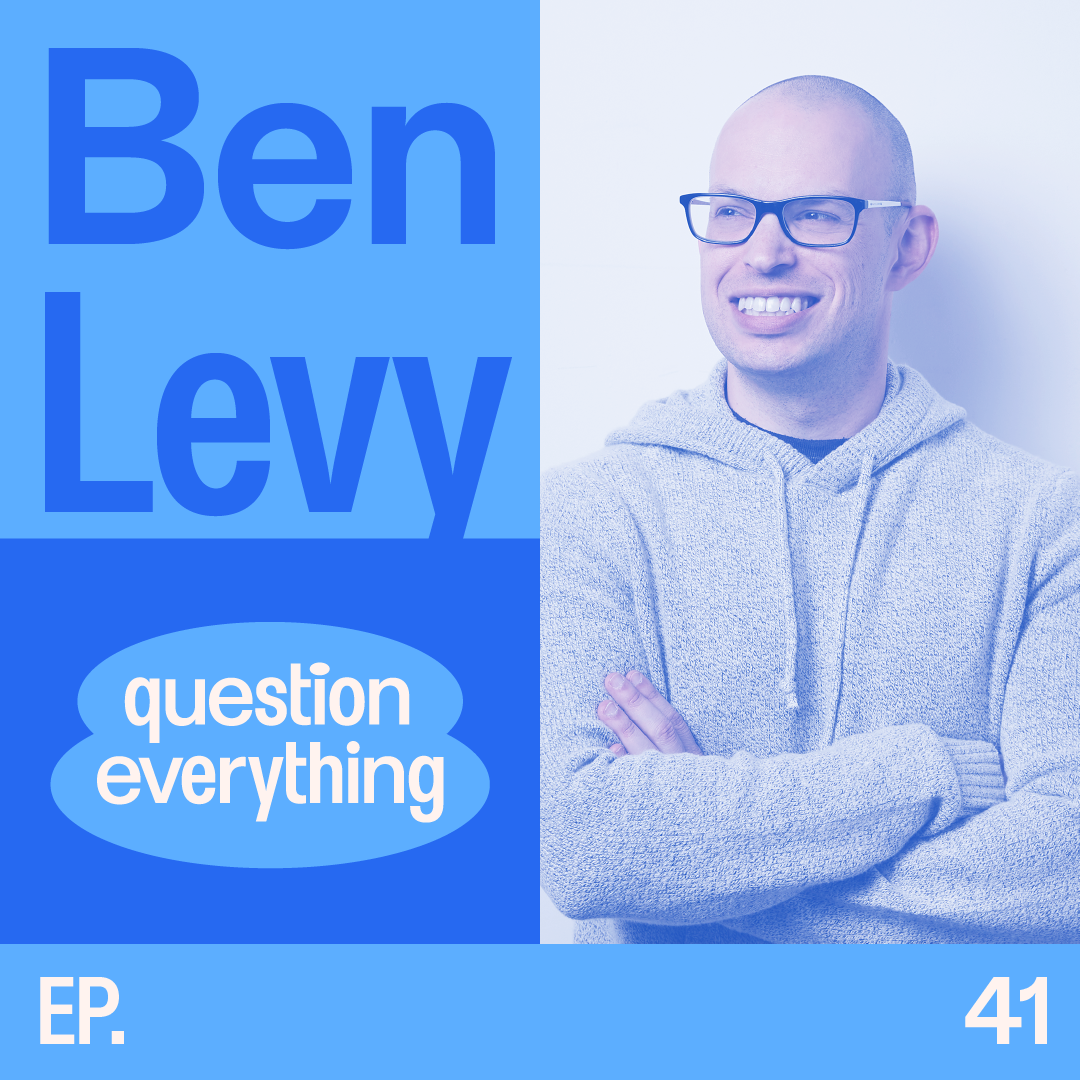
Ben Levy is a Presentation & Pitch Coach and former Creative Director best known as the founder of Sell It Great, a coaching program that helps creatives and agencies sell their best ideas with confidence and clarity.
He works with everyone from interns to executive creative directors, teaching teams how to build presence, develop a repeatable pitch process, and present ideas that win business. His clients include leading agencies such as Droga5, Mischief, FCB, and VML, as well as brands like Amazon and Campbell’s.






Like most creatives in ad land, Ben was taught how to make great work, not how to sell it. He let his work “speak for itself” until he realized that great ideas don’t win unless they’ve got a great pitch behind them. With few actionable frameworks or guides available, he took matters into his own hands, teaching himself the art of pitching. That journey led him to build a 10-session course, author two books, and coach some of the industry’s top creatives on how to “sell it great.”
In this episode of Question Everything, Ben shares how to uncover the invisible brief every client has, shake off presentation nerves, and answer the four questions a pitch must address to win.
Learn more about Ben and his Sell It Great program on his website
Hello, everyone. Welcome to Question Everything, a podcast all about learning from the successes and the failures of those who dare to, well, question everything. This podcast is part. view part of view, part therapy, and part price is right. We have our own game board stacked with questions that'll make even the most successful CMO sweat. I'm your host, Ashley Walters, CMO and partner at Curiosity. On today's episode, I sit down with Ben Levy, a pitch and presentation coach who's helped agencies, ad execs, and CMOs sell in their best ideas. On this episode, you'll learn the surefire way to turn nerves into excitement. How to sell in your best work by answering four simple questions. Questions: why the client's hidden motivations are actually your invisible brief. So grab your grappling gloves and prepare to knock out your next pitch. This episode will give you the confidence to punch above your weight class. Let's get started.
Learn more about Ben and his Sell It Great program on his website
00:01:04
Ben Levy is a presentation and pitch coach, creative director, and founder of Sell It Great, a program built to help creatives and agencies sell their best ideas with clarity and confidence. Before working with the greats at Mischief, Droga 5, and 72andSunny, Ben spent 15 years creating award-winning work for brands like Coca-Cola, Liberty Mutual, Sony, and Planet Fitness. Whether he's elevating your presence, building a repeatable pitch process, or literally writing the book on perfecting the pitch, one thing's for sure: Ben will get you and your team to stop reading slides. Ben, welcome to the show. Thanks for having me. I feel like maybe we should cut it here. That sounded fantastic. I mean, what's the impression to me? You have an incredible reputation, I must say.
00:01:53
And I got to spend an entire day with you. Our whole agency did really and got to know you pretty well. So I'm excited for this combo. So much I'm excited too, any excuse to hang out with any of you for more time. I'm gonna take it. Oh man, I love that. So, um, your second book just dropped. Tell me, tell me a little bit about it going? How are people receiving it? I read some reviews that were really good. It's. It's been really, really interesting. The process was very different for the second book. This one's called The Perfect Pitch Planner, and it is intended to be a workbook companion for Stop Reading Slides, the first book.
00:02:38
It's generally difficult for people to put me next to them and have me look over their shoulder every time they're preparing for a pitch. The planner is supposed to be a better alternative for that. Got it. Still has terrible jokes, but. Otherwise, it will help you go page by page, step by step, through everything from a blank page to a final presentation. The same way that I do it. Love that. Because there's a lot of stuff that I say and recommend. People do not have perfect recall. So it's fantastic when they grab a piece or two. And it changes their approach and changes what they can do. Awesome. Awesome. So if you don't have a tiny little bend sitting on your shoulder, then you must buy the companion piece to the first book.
00:03:28
I'm excited to dig in. That's for sure. I'm excited for all of our listeners to learn a lot more about your philosophies, your thinking, your career. We are going to dive into all of it today. You have to spill all of your juicy secrets. I am terrified. All right, well, let's get into it then. I like that. Let's pull up the game board. All right, where do you want to go first? I've never been so frightened by a series of random numbers. Let's go lucky number seven. Why don't we start there? Okay. Number seven.
Learn more about Ben and his Sell It Great program on his website
Most clients have an invisible brief. Tell us a little bit about this brief and explain it to us. So to understand the invisible brief, you need to recognize that a presentation, a meeting, is just another form of advertising.
00:04:24
In an agency context, in a marketing context, we're all experts at convincing people of things. And most of these people are strangers we'll never meet. Yeah. But then. The second we walk into a meeting, where we actually have some kind of context and relationship with these people. We leave all of the best practices that we know. outside of the meeting room. If a meeting is basically an ad for the ads you want to make, thank you. You should have a brief for that ad. And the invisible brief is a series of questions that I encourage people to ask before walking into a meeting to make sure that they're. They've got the right audience in mind. Things like. What are the values of the people who are going to be across the table or through the camera from you?
00:05:11
Mm hmm. What is the actual purpose of that meeting? It's amazing how many times we go into the room, and we don't actually have that laid out. So what are you trying to achieve? Do you need approval? Do you just need to know that you're going in the right direction generally? What's success really look like? What are you really aiming for? You can get further than that. You can go higher. Don't shoot yourself in the foot trying to bite off more than you can chew. Yeah. Let's get the basics. Get started with the basics: what is the real motivation for the people that you're meeting with? It isn't that everyone that we meet in a business context is a cartoonish, one-dimensional villain.
00:05:54
But when you really break it down, there's going to be—one overriding force, one overriding desire— that's driving them for that particular meeting. Thank you. It could be that they're interested in increasing their fame or the fame of the brand. It could be that they're really concerned about money, and they need to make sure sales are up. Sales are always going to be a piece of what we're talking about. But in certain meetings, that is the thing. Yeah. It could be that they're interested in power, and yes, there's like the twirling mustache, evil villain, Machiavellian power piece of that, but what I really mean is control, responsibility, impact, right? You'll have people who will say, 'Look, what's important to me is that this thing is done right and that it has this outcome.' And so understanding those motivations means that you're able to communicate your ideas in a way that lands for your audience.
00:06:55
Hmm-hmm. We often miss is that were never, ever. Presenting ideas to the people those ideas are for. I've never received the brief that said, 'convince the CMO of Coke to drink more of his own product.' Thank you. It's always going to be. Tweens with disposable income or empty nesters who want to celebrate like they remember celebrating when they were kids or whatever it is. It's not people who run a multinational corporation and are used to looking at marketing plans. They're never the target of the brief. So we come into these meetings and in our head, we're locked in on the consumer who's not in the room. And anytime that you've talked to somebody and you've gotten back, 'Oh, I've never heard of this influencer.' Oh, is that a thing the kids say?
00:07:43
Or is this idea really going to land? Doesn't make sense to me. This is because you've failed to consider the invisible brief. And you've wound up speaking in the consumer's language. To your audience in the room, and they're not the same person. Is this an actual like— do you recommend agencies actually write this down on paper? Talk about it before the meeting? Like it's an actual physical, living, breathing document? Or is it just something that you kind of think of, you know? And you kind of walk into the room and. I think ideally it. It becomes second nature in the beginning when people first learn about it. Yeah, I do recommend having the question somewhere, write them down. I mean, that's what the planner will help you do.
00:08:27
I don't want to give the strategy department a second task. Yeah, it's not— they're not supposed to be sitting there and figuring out, scratching their heads, right? What is the brief for this thing? If you can't quickly answer it, then that's probably a sign that you're not prepared for the meeting. Do more of that prep work that you need in order to really set yourself up for success. But it shouldn't be the kind of thing that takes deliberation. Let's write it down and be absolutely sure. Unless you feel like, well, I'm handing this off to somebody new, yeah, let them know what they're in for, yeah. I mean, we did a really quick exercise— just pick one client, and within that client team, you've got four or five different motivations.
00:09:10
Each person is kind of coming in to the meeting, who's motivated by something differently, jobs. security, sales, brand fame, as you said. And so, thinking through how you even position your ideas to them and like speak to them in their own language, I think leads to you selling braver, bigger work. Fundamentally, this is about relationships and trust. So you're talking to people who have approval power, they need to understand what's in it for them. And not in a way like they don't care what's good for the consumer. But in a way that because they care about what's good for the consumer in a particular perspective, through a particular lens. You need to help them see it clearly. And that's going to be tapping into what their various motivations or values are or what their goals are.
Learn more about Ben and his Sell It Great program on his website
00:09:59
Great. Great advice. All right, let's go back to the board. Let's go 10. What is the single most powerful tool we have as a presenter, and how do we use it? Like this. Yeah. Silence is the single most powerful tool a presenter has. Far and away the strongest thing in your repertoire. And we generally aren't. terrible at using it. Because silence is uncomfortable. Yeah. doubly so if you're in a remote presentation. where it feels like any second of silence or any pause is somebody having an audio issue, or your screen froze, or whatever it may be. But the truth is that the most confident thing you can do is stop talking. It doesn't have to be for long.
00:10:54
But if you get comfortable with silence, you not only reduce filler words, because ums and uhs come out because we're uncomfortable with the break in sound. But you also emphasize whatever the last thing is that you said. So, silence, the way that our brains process silence, they essentially run back over the last thing we heard. So it's as if you imagine that you've just underlined and highlighted whatever the last statement was that you made. So sometimes people will get excited, and they'll speak really loudly or they'll pound on the table, to be dramatic in some way, when really, if you want to underscore your point, if you want to put an exclamation point at the end of whatever your statement is, the best thing you can do is say it and stop talking.
00:11:46
I am here for this in so many ways. I often tell the team there's power in a pause. Just let it sit there. And sometimes we talk our way out of it, out of things. Like, you land a point, and then you keep going, and you won't shut up. And it's like, no, just end it. Let them react. Let them talk first. It's a really powerful strategic move that's very overlooked and uncomfortable at times. Also, the sort of thing that if you're going to use it, warn everybody else who's going to be on the call on your side. Because early on, I remember after I learned this and got more comfortable with it. There would be times where I would specifically refrain from answering something.
00:12:34
Or from you, know allow that silence to build, if I asked a question, because I wanted the client to be the one to answer it. And other people on my team would panic, and they would jump in and try to fill that silence, like it was a live grenade. No, no, no, no, just not for you. Ben's glitching. Thank you. Yeah. Oh, God, he froze. Go, go, go. No, guys. Oh, Lord. All right. I appreciate it. But stop that. Don't do that again. So yeah, I will frequently warn people right before we get on the call. I'm going to ask questions. I want them to answer. Don't answer them. Yeah, and you'll still see people sort of get the shakes and start sweating.
00:13:13
How do you recommend, so people who are uncomfortable pausing or stopping, do you recommend practicing? Is there like a technique or anything or just go and try it? One of my favorite things to do is play the 'um' game, and I say, one of my favorite things to do, but really it's it's to make other people play it. And that is where you pick a topic and record yourself for two minutes talking about it, everything you can think to say. The rule is you can't say 'um'. If you do, you're done. That forces you to be okay with silence because, when you run out of words on a topic, a lot of people's first instinct is to go, uh—, as they look for the next one.
00:13:58
You need to just hold that silence, or you'll never make it through two minutes. The more that you do that, the more comfortable you'll become with it. Thank you. The other thing that I think is really valuable— and people never want to do— is watch yourself playing the game and those moments where you pause and try to figure out what you're going to say next. Take yourself out of that moment emotionally. You're gonna feel awkward. You're gonna hate it. You're gonna see yourself on camera and hate that. But try to be a dispassionate, objective observer. and ask yourself if that person in that moment looks like they're confused. Or it looks thoughtful. Because people get really nervous about silence. They think, 'Oh my god, I'm supposed to have the answer.
00:14:51
I look stupid.' They're all laughing at me. I need to figure it out. I need to figure it out. I need to figure it out. And it just becomes this spiral. But actually, that process where you're thinking looks thoughtful. No one ever believes me. That's why you have to record yourself and then watch it back. And once you realize that, it takes a lot of the pressure off. Because everyone would like it if the people they're talking to appear to be thinking about the actual conversation happening. As opposed to just trying to riff for an answer and get over it. I got to tell just a really short story. But I remember very early on in my career, we were rehearsing for a huge client meeting.
00:15:34
And I'm probably 23 and a half or something. I'm very, very young. So it was a really big deal for me. I'm rehearsing, and you've got an SVP on this side, and a president on this side, and everyone's judging you. And I get done, and I walk over, and my boss pulls me aside and shows me his piece of paper. And he had 22 tally marks. And he said, 'You said 22 times.' And I would have bet you a million dollars I didn't say it once. I had no idea it was standing in my way. And I remember going home and practicing in front of the mirror, and practicing in front of my dog, and going on video, doing everything I could to eliminate that word from my vocabulary at least for that meeting.
00:16:19
Pausing was how I did it because it allowed my brain to catch up to the thought that I wanted to say next. I knew what I wanted to say. I knew the topic really well, but I was just getting so ahead of myself. And I didn't say, 'I'm the next day.' And he remembered that. And that was when I first started to get into business development, too, because I think the presentation went so well. They were like, 'Oh.' She might be okay at this thing. The beginning of my career. A very unfair standard that exists where we never seem to get that opportunity until somebody else gets like a stomach flu. And then you only get one like every two years. Yeah. So if you nail it, it's 'Oh!
00:17:00
That's your thing now!' Yeah. And then if you don't. Which would be totally natural, because how many times have you gotten to do this before that? You're like, 'I guess I've got to wait another two years for someone to get sick.' This is not. There's no plan for this. I think. I think things are getting better, and I'm trying to help out how I can. Yeah, it's yeah. There's so much in those early days where, um, was not my biggest problem, but having any sense of comfort or confidence. And I was just trying to downplay my own existence as much as possible. And I was thinking, just the work is here. Choose the work. I'm just— I'm just here to move the slides along.
00:17:43
Like, ask me if you have a question. But this is what we've been doing. And you look back and realize, oh, you looked like you couldn't care less about it. You looked completely disconnected from any of this. No passion, no interest, no nothing at the time. I was just. Let the earth swallow me whole. I just want to be anywhere but here. I just don't want to be in this position. Why are you making me do this? Yeah, yeah. Just. I don't. I feel like I've done something wrong and I'm being punched. That's right. That's right. I mean, I think our bodies, how we show up, the passion, our inflections, it all plays a role in how an idea is perceived and can help sell in good work. So much. Yep.
Learn more about Ben and his Sell It Great program on his website
00:18:25
So much. All right. Let's go back to the board. Let's go 12. I feel like there should be some strategic thought I'm putting into this. And it's really just a random number generator that's powered by ADHD. One day I'm going to do a post or something on the psychology of how people pick numbers because it is absolutely fascinating to see each guest and how they do it. Versus the strategy, everybody is just a little different—I love it all right. So this question is sponsored by our friends at Mischief. I know Greg Hahn wrote the foreword in your book. So I reached out to my friend, Ollie, who I know you know very well, and said, 'If you could ask him one question, what would it be?' And here's his question.
00:19:05
So presenting can be emotional. What's your go-to move for shaking off the nerves before a big presentation? There's two. So the easier one, the quicker one, is I pick some music that gets me pumped. I'll do walk-on music that I'll listen to. Before coming to do it. I mean, it's— it's music that's like a hack for humans to change your mood and your energy level. And that's just really simple. And it's, it's like the worst stuff too. It's like some kind of pop clubhouse, like something with a you know, with a solid base behind it, like I can tell you. I try not to go show tunes because then it's going to be in my head the whole time.
00:19:53
Anybody from my company who's listening to this right now is like crying, laughing because my pump-up song is from the Trolls movie. And I get made fun of so much. But I mean, I can't stop this feeling. It's like such a good song. I get so hyped. Justin Timberlake. I am so happy listening to that song. Oh my gosh, they make fun of me so much. I have. I can't even remember who the artist is. The song is literally called 'Let's Go.' It's probably my most common. And I think those are the only two words in it, too. It's just perfect. It's not like good music, but it's great walk-on music. So that's one way to do it because that'll elevate your mood. It'll change how you're feeling.
00:20:40
You'll have energy. It'll wake you up. The other thing is, Nerves are a lie that we tell ourselves. Nerves are not real. And I really love to share this with people because it's like saying that Santa is real. Nerves are not real. Responses that we have in our body—those that we are calling nerves— if you stop and think about them, they're what my leg used to shake all the time. I would have an elevated heart rate. I know a lot of people. Their mouth will go dry. Some people will shake, or their voice will catch. You get fidgety. Yeah. Now, if you think about a time when you were excited and anticipating something. If you think about getting ready to ride a roller coaster, or you're seeing a friend you haven't seen for a year and a half.
00:21:39
Yeah. How do you feel in your body? Same way. Sometimes you feel like antsy, like you have a lot of energy, you almost start to shake, you feel like your heart rate gets elevated, you want to run to them, your mouth gets dry. It's the same physiological response. The only difference is how your mind chooses to interpret those signals. So adrenaline is real. Adrenaline is what's causing those symptoms. But whether they are a sign that you should run or a sign that you should like start to party is entirely up to your brain. And how you choose to interpret it. And. If you start to reframe that in your own head, if you can catch yourself before having a big talk and go, 'Okay, this is not Nerves.
00:22:30
This is actually, like, I'm, I'm ready for this thing, like, I want to do it, let's go. Do that four or five times. It's amazing how quickly you can rewire that response. And it's funny that that question came from Mischief, because the first time that I ever went and spoke at Mischief. I was there, I was in my hotel room the night before, and I actually had a moment of going. It's weird. My heart is racing. What is going on? And then caught myself and went, 'Oh, no, that's what, okay.' I'm like, 'This is a big thing. Like, I'm excited for this. This is cool. I love that so much for so many reasons.' I get asked a lot by people, do you get nervous?
00:23:15
And my answer is always no, I don't get nervous, but I didn't really know why. And I think you just explained it. Me, I, get some of those feelings, but I don't ever describe it as nerves, and so I think now I have a good answer for that. I am excited. I do get excited. I get maybe a little jittery, or my heart will race, but I would never describe it as nervous. That's really smart. And I think, yeah, we have to rewire our brains because we are built for this and we're ready for this. And, you know, all of our experiences led to these little micro moments too. And there may be people who listen to this or watch this who are going, nope, sorry, my nerves are way too bad.
00:23:58
I'm full-blown panic. What you're talking about is not real. And there is a difference between what we're talking about right now with that. Adrenaline in those symptoms and actual panic. Yeah. So, the times that we have seen someone fall apart publicly, the times when they shake visibly or you hear someone's voice crack. That's panic. Yeah, and that started as the kind of thing that you and I are talking about right now— just a racing heart, or maybe someone's sweating more than normal. Whatever it may be, and then they let that get in their head. And it spirals. And that's when you get to a point where all you can hear is like the screaming of your own ego, just asking you to do anything else right now than be here.
00:24:49
If you realize that these signals are not telling you that you need to run away, not telling you you're in danger, then they'll go away. Hmm. And so. Then you never reach, whether you call it nerves or not, you never even reach that point of panic. And that's where you're able to. To get through it. It's not as dramatic as it may have been earlier for you before you started to process those differently. That's good. So we have to reframe the feelings that we have. Those are all real. But reframing it as 'I'm ready' or 'excitement' can help trick the mind. And eliminate the nerves. I like that. Okay, that's really good advice. I will also just add one other point.
00:25:32
Um, I realized pretty early in my career also that I'm never allowed to hold an ink pen that clicks while I'm presenting. Because I will just click it the whole time, and I won't hear it at all. But everybody around me will be like, 'What happened to that ink pen?' So I can't. I can't hold an ink pen. I used to believe that if I stood with one foot just slightly off the ground, that people wouldn't see my leg shake. They probably saw me like bent over, weird, like a stork or something. The entire time, instead. I mean, I. A flamingo. Yeah, just so many mistakes when I. Before I learned any of this. I'm here for it. I love it. All right. Let's go back to the board.
Learn more about Ben and his Sell It Great program on his website
00:26:16
All right. To the board. Now I feel like I'm making a pattern. I didn't mean to, but I guess we'll go four. All right. I figured four or two. Okay. So, how should a presentation change when it's virtual versus in person? One of the big challenges with a virtual presentation, even more so than when you're in person, is this habit we have of taking the slides. And throwing them up and making that the meeting. Hmm. Yeah. Hiding behind your deck. Yep. And. That's also something that you can do in person, and you want to avoid. But in person, you're still physically around. People will see you. When you're in a virtual meeting, and you share screen, in some cases, depending on the software, how many people are in the meeting, what their layout on their screen looks like at home.
00:27:13
You literally take yourself out of the meeting. You're no longer there. They can hear your voice. But at that point, it should have just been a phone call. That is again talking about a meeting as the goal is to transfer trust. The goal is to build relationships. The work is important. But, if the client loves the idea and doesn't love me, they're going to find reasons not to make the idea or even work with me. If they like me but don't love the idea, I'm coming back. Yeah, I'm getting another at bat. And so, the thing that is most important is to build that relationship in the meeting and to have that connection. And when you share screen virtually, when you set it up so that you're the one speaking and everybody else can just hang out on mute, and hold questions till the end.
00:28:13
You are basically making the deck the whole thing and removing yourself from that meeting as much as possible without actually exiting. So, do you recommend like not pulling the deck up right away or up and down, or how do you know the deck? How do you get through it in a way? I think. as much as possible. No deck is a wonderful thing. There are times when I haven't had one going into a meeting, if we're there to show work, it's just here's the work, yeah. I also think that's rarely something you can get away with yeah, so I recommend for sure not putting the deck up first thing, yeah. Let some conversation happen before you do.
00:28:58
All of the changes that I make in a virtual presentation are designed to bring in as much of that benefit of meeting in person as I can.
Learn more about Ben and his Sell It Great program on his website
Let's go back to the board. Two, let's go. I figured, number two, what are the four most powerful questions you can answer to persuade a client during a pitch? There are four questions that every successful pitch that I've ever been a part of, that I've ever heard about, or that I've ever seen reviewed from someone else has answered. And those four questions are: Answering how the world is. How the world could be. How you're going to make that vision happen. How the world could be. And the last one is how the world will be.
00:29:53
And if you answer those things, every successful pitch has answered them, usually by mistake and with a lot of bloat and misdirection and things in there because they didn't set out to do it intentionally. But if you focus on those four questions, number one, you have all the ingredients you need to win. Doesn't mean you will every time. But you're going to have a real difficult time without answering them. And number two, it also makes a very clear story arc. Hmm, yeah. For you to tell in that meeting without you having to try and force that story in. Yep. Oftentimes we're all assembling by department in silos the different things that we think are going to be important evidence of all the work that we've done and how hard we've been been grinding for our client and then we mash it all together into a deck and somebody looks at it and goes, 'Uh, maybe if we move these parts around, it'll be like a story
00:30:51
But if you start with those four things, and then take your content and go, 'I think this part answers this, and this part answers that, and maybe this part isn't really needed to answer any of these— we can put that over here you wind up with a story by default and it becomes much, much easier for you to share that in a meeting. All right, I'm going to put you on the spot here, a little improv. Do you have an example from a previous life, maybe, or maybe we make one up on the spot, but one that you could kind of walk me through that answers those four questions. So, how a story might come to life. A campaign that REI did a hundred years ago during Black Friday where they closed their stores.
00:31:34
I remember that. Have people go outside. Yep. How the world is, is that the biggest sales day of the year, there's a ton of competition. Everybody's trying to shout over one another. And. Also, it kind of flys in the face of everything you stand for, because you're not really about commercialization and the owning of stuff. But how the world could be. Is that you can find a way to actually outshout everyone. By being quieter. And at the same time, you could reinforce your values and really, in a very broken metaphor, put your money where your mouth is. And how you'd make it happen is to just announce that you're closing your stores on Black Friday. People literally cannot come buy stuff on the biggest day of the year because, to you, it is more important.
00:32:30
That everyone goes outside, and that your employees can go outside rather than partake in crass commercialization. And if you do that. Then you'll be able to create how the world will be, which is one where without having to outspend, out coupon, or out shout everybody else. Your silence will be deafening. You will own that conversation on Black Friday. You'll get to give your employees a break. You'll make your core audience love you. And we believe that sales will come bouncing right back the next day. Bravo. That was so good. I mean, where do I sign? And you weren't even nervous. Look at that. Just excited. Just excited. Oh, man. Ben, this has been amazing. Thank you so much for coming on the show. Thank you for having me. Yeah.
Learn more about Ben and his Sell It Great program on his website
00:33:28
So we love to end these conversations with a little 'this or that'. Don't overthink it. I didn't think you would anyway. But just a way for our audience to get to know you a little bit more. Are you game? All right. All right, pitch theater or no pitch theater? Generally, no pitch theater. Man, that should have been hiding behind one of those numbers because there's so much for me to overthink here. I know it really. I know it was at one point. All right. Next question: martial arts or salsa dancing? Definitely martial arts. I once failed a salsa dance class. I read that. And I blamed it on the martial arts because all the footwork's different, but yeah. All right, delivering a keynote or writing a book? Bye.
00:34:14
I'm going to say delivering a keynote. I like writing, but it is a much more exhaustive process. All right, well, virtual or in person? In person. It's always more fun in person. Ping pong or foosball? That's foosball? I'm going to say foosball. Was that the hardest decision you've made all day? I think so, yeah. It was even harder than deciding what to have for lunch. I've gotten really good at both those things just because of agency life. Foosball was the first. This was so much fun. What's the best way for folks to reach out to you? My website is sellitgreat. com and if you go on LinkedIn and search for sell it great. It's a fantastic way to stalk me. Email me directly at ben@sellitgreat. com. Awesome. Thanks for coming on the show, Ben. Thanks for having me.