
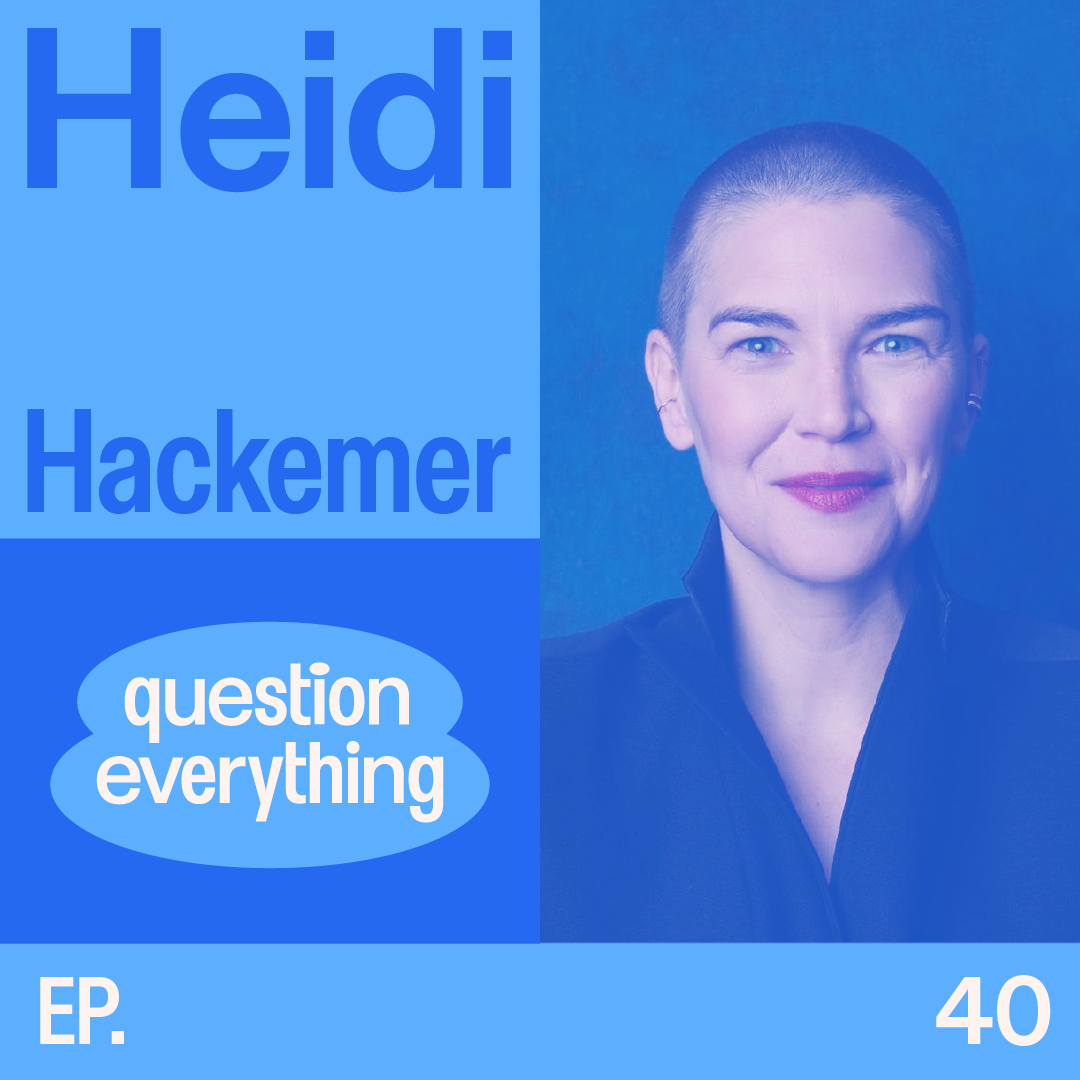
Heidi Hackemer is a trusted strategic advisor to many of the world’s top leaders and organizations. Rooted in the practice of narrative and brand strategy, Heidi has worked with organizations like Nike, Microsoft, Ford, Unilever, lululemon, Google and the Obama White House, as well as start-ups, non-profits, funds and philanthropies, to build braver brands that cut through culture.






Heidi Hackemer is the Principal of strategy consultancy Hackemer, where she fearlessly tackles the brand world’s most interesting challenges. Her approach to breakthrough strategy isn’t flashy – it’s rooted in the fundamentals. From Google and Nike to the Obama White House, she’s started every assignment the same way: the 4C’s framework, a whiteboard, and a Diet Coke.
In this episode of Question Everything, Heidi shares what brands can do to create space in a crowded landscape, what legacy brands need to make a comeback, and why CMOs need to be the bravest people in the room for a brand to grow.
Hello, everyone. Welcome to Question Everything, a podcast all about learning from the successes and the failures of those who dare to, well, question everything. This podcast is part interview, part therapy, and part Price is Right. We have our own game board stacked with questions that'll make even the most successful CMO sweat. I'm your host, Ashley Walters, CMO and partner at Cure. curiosity. On today's episode, I sit down with Heidi Hackemer, a renowned strategist behind some of the world's most high-stakes work, including the White House. On this episode, you'll learn the first question to ask when you want to break through. What really went on inside Oatly's brilliantly bad Super Bowl bet, how legacy brands can get their edge back, and why every deck should sing like classical music. So grab your helmet and fire up the Harley. This episode will help you leave sleepy strategies in the dust. Let's get started.
00:01:04
Heidi Hackamer is a trusted strategic advisor to many of the world's top leaders and organizations. Rooted in the practice of narrative and brand strategy, Heidi has worked with organizations like Nike, Microsoft, Ford, Unilever, Lululemon, Google, and the Obama White House, as well as startups, nonprofits, funds, and philanthropies. To help them focus their power towards a radically better future. Whether she's evaluating global communications, sharpening a Super Bowl ad, or galvanizing a leadership team, when Heidi's behind the work, you know it's going to be equal parts brilliant and unconventional. Heidi, welcome to the show. Thank you. Thank you for having me. I just love your bio. I'm like, alright. Is there anybody that you want to work with that you haven't had the chance to work with? There's always somebody.
00:01:53
I want to work with Harley. That's who I want to work with. I feel like let's just tag them. And yes, let's make that happen. Well, it's so good to see you again. So we just met recently for anyone listening. Heidi came to Curiosity, and we did a day-long strat day where you imparted your wisdom on our strategy team, our creative teams, and our media team. Talk a little bit about what that session entails. It was such a great, first of all, you have such a great team. Like that was just like a good soul day, you know? And I think, you know, where I like to start these sessions is starting with the person themselves. And letting them see themselves in the most positive and powerful light, which we don't do a lot, you know?
00:02:39
So, I think that's really important for strategists and for anyone. Well, anyone in the world, but especially people working in the creative industry, because when you can find that mojo in yourself, it makes you so much more effective when you're working with clients. So I really love starting workshops there. And then we get into, yes, these are some tips and tricks around brand strategy and client management and things like that. But I really think the most important part of these days is having people see themselves in a fresher light. Yeah. One of the things you had us do, we had giant post-its with our name on it. And then everybody went around the room. And wrote something about you, how they perceive you, or something they really admire about you, and then by the end of it, your post-it was full of really, you know, a lot of your superpowers.
00:03:27
I think it's a good way to frame it. Yeah, I think we need to do that more. We need to take care of each other like that. And that's why I really love doing that exercise. I think people should do that. Do it this week. I love it. All right. Well, you've seen the show. You know how this works. I have a game board stacked with 12 spicy questions. I don't know what's behind each number. You don't know what's behind each number. But the power is absolutely in your hands. So. We will go ahead and pull up the game board. Which number do you want to go to first? We're going to start with my lucky number, which is 12. All right, number 12.
00:04:02
Take us behind the thinking behind Oatly's 'Wow, no cow' Super Bowl spot and why Oatly printed 'I totally hated that Oatly commercial t-shirts' before it aired. Okay, so look, I joined Oatly September before the Super Bowl. And this was one of the first big discussions and decisions that had to be made. And, you know, we were gaining in the marketplace, we were opening new factories, we were going towards IPO. And plant-based milk was really taking off. So we decided this was a really good time to do a huge awareness moment for the brand. Now, in classic Oatly fashion, you know, Oatly is always. Can I swear on this podcast? Yeah, absolutely. Oatly's always like fucking with advertising norms. That's such a big part of what made that brand famous. And so when.
00:04:53
We're like, do we want to do the Super Bowl spot? There was never really a discussion of creating a new spot from scratch. It was really just pulling the dumbest spot from the archive and throwing it up on the Super Bowl. So that spot was made for Finland, I think, a couple of years before. I think parts were shot on an iPhone. If you look, there's a part where we zoom in on the pack because the pack is sitting on the piano that Tony Peterson, our CEO, is playing. You can see the gaffer tape that they had to jam the package on. Because when we were playing the piano, the package kept falling off. So there's no like package styling, no lighting, like nothing, nothing.
00:05:33
And it was such a classic Oatly move because it was so, it is still today. So counter to what goes on in Super Bowl spots. That highly produced. I mean, you can, there's just these formulas. I mean, I actually think the Super Bowl has gotten quite sad. Like, the formulas are just boring. We all know there's like three types of spots and like, you're going to run one of those three types of spots on the Super Bowl. And this was definitely not one of those three. Right. And so it was fun. And we also, Oatly's very strong at understanding internet culture. And we knew—factually— that the haters were going to come out and be like, 'What was that? That was stupid, blah, blah, blah.' So we're like, okay, let’s just like pre-print the t-shirts.
00:06:13
So what we did is we had these t-shirts pre-printed that said, 'I totally hated that Oatly commercial.' And there was, like, two or three hundred that we had printed. And you could get them for free on the website as soon as the Super Bowl spot went live. But what we also did is that in certain cities, we had couriers on call. And for people that were hate tweeting against the spot, we got in touch with them. And for many of them, they had the T-shirt delivered to their door before the end of the game. Wow. Yeah, it was fun. Wow, that is like knowing your audience so well. I love that. What do you say to people who are like, that was the worst Super Bowl spot, like brand, like CMOs are like, oh, that Oatly spot, because it performed really well, right?
00:06:57
Oh, it performed well. Our awareness shot through the roof. Our sales, bomb. People who never heard of Oatly before. Like, here's the thing. Like, this is one of these things where. It's like no publicity is bad publicity. Like we knew it was a dumb spot. Like when people say, 'Oh, that was a bad spot,' we're like, 'Yeah, no shit.' Like that was the point. That was the point. And the point wasn't about winning by making the most glorious spot. The point was winning by driving conversation that no other spot would have conversation. Said so well. Great advice. All right, let's go back to the game board. Okay. Um, let's do now. I don't care. I don't care about any of these numbers. So let's do do number two.
00:07:42
Okay. Is there a story behind number 12 I need to know? I was born on the 12th. Okay, great. It's always been my number. All right. You worked on digital strategy for the Obama administration. What carried over from consumer brands, and what didn't? Great question. I'm a big believer that brand strategy can stretch into almost any realm. And the reason I'm a big believer in that is that I've spent my career experimenting with how far it can stretch. Where can you take the skill set, and what can you do with it? I went in because I'm not a digital strategist. I'm a brand strategist. I love my digital strats, but I'm not one of those. So basically, we went in for a two-week sprint and we
00:08:28
Basically, just moved to DC for two weeks and had full access to the West Wing and the Eisenhower Executive Office building. So we were like running around, these weirdos. And the brief was, we're not breaking through. So how do we break through? And I think what they thought we were going to come back with was like an optimized Twitter strategy. Which we didn't. What we actually came back with was— you need a better understanding. You need an overall message that the country wants to hear right now. You need to umbrella it. Um, because you started with hope, but now you're, I came in 2015. It was like what they call the fourth quarter— like no more midterm elections. The president is basically, and he wasn't going to run again because he couldn't run again, which we should all pay attention to.
00:09:09
You cannot run for a third term. OK. So, fact, constitutional fact. OK, so anyway, like, you know, this is the last few years where they're not worrying about elections. And so, what came out of that recommendation was. Here's the message that you need to in the vibe that you need to be putting out for your last, you know, couple of years. And actually, what you need to do is when we see this in government all the time, and we see this in some major corporations. Where their engagement strategy with the world is centered around the discipline of comms and press. And so you have people that came up through comms and earned media. Really driving the engagement strategy, which is a little bit different than our world. And so.
00:09:56
The White House is really centered around the press. This is why we have the daily press briefings, right? Like that's how the White House has been built historically. And what we said to them is: you need a complementary department called the office of what was that, ODS, Office of Digital Services, that is really looking at your digital engagement. So actually, the recommendation at the end of the day was: this isn't how you like get better at Twitter, but you have to set up a separate team that this is what they do and they work with the comms team. But they have their own remit and properties, and they fire forward. And on the consumer brand side, you know, you think about Nike and Oatly and like all these amazing brands that you've worked with.
00:10:35
A lot of that rings true over there, too, right? I mean, look, I say this no matter where I go. If I go into politics, nonprofit, whatever, like people are people. And you want people like us helping you. Because the companies that we work with, like Nike, Google, Coca-Cola, McDonald's, whatever, have defined how people take in information and how they relate to brands. And we know how to do that. Now, this is changing a bit now that the algorithms are basically dictating what people see. So it's, this is like, this is shifting right now. But in those spaces, I always say, like, they'll say, 'Well, we're different because we're a nonprofit or we're different because we're government.' And it's like, you don't make the rules because you don't spend as much money as those guys do.
00:11:18
Those guys have actually defined the landscape. So let's understand the landscape that they've defined when it comes to brand engagement and make sure you are exploiting that. In the best way possible, mm hmm. Make sense? All right, let's go back to the board. Okay. Uh. Let's do number eight.
Tell us more about the three dimensions of breakthrough, and you describe them as risk, values, and difference. Yeah. Okay. So this is what we did the workshop on was about breakthrough. And basically every client that I work with right now is like, 'How do we break through?' This is such a messy environment where people's attention is being split a thousand different ways. How do you break through?
00:12:00
Whereas, like, you know, 10 years ago, the question was, 'How do you go viral?' Now it's, 'How do you break through?' And really, at the heart of it, it's about an organization. Having a very strong sense of who they are and what they stand for. And then deciding if they're going to push it or not. When we have risk, it's how far are you willing to take a risk on things? How far are you willing to provoke? Oatly loves to provoke, right? Oatly would almost like poke at the dairy industry and be like, 'Go ahead, sue us.' We want to be sued. We want to be sued, right? Because they knew if they got sued, they would get a lot more attention in a market.
00:12:40
So that's like a high-risk strategy. Patagonia has done risk in their work where they have put tags on their shirts that say 'Vote the Out' or 'Vote the Out Right.' So that's a risk play. Where you're willing to alienate to get people to pay attention to you. Now, the second or the first one—sorry, I skipped to risk. The first one is 'Values.' Values is people getting a lot of attention just based on a very strong value stance that not only saturates their marketing but also saturates their company. So Tony Chocolonely, I think, is one of the best examples of this. We talked about it in the workshop. Where they are so values-driven, they are so against slave labor and child labor in the chocolate supply chain.
00:13:22
And that's just what they center everything on. And it's not about being gimmicky or tricksy. But everything from their packaging to the way their product is split up to the way that they spend their money on lobbying more than they spend their money or a lot of money spent lobbying as well as marketing values. Right. So they are just attracting people like, you know, flies who are really into values. And then there's difference. And difference is about just kind of like being weird for the sake of being weird, right? Like just kind of breaking rules because you know what's going to make you stand out. So we saw this with Liquid Death, and I know we've talked about this. This brand forever. I don't want to talk about Liquid Death because I'm bored of everyone talking about Liquid Death.
00:14:03
We talk about it with Duolingo. This is also a place, going back to Oatly, Oatly did this really well, where it's like, we're just going to do something really different and weird on the Super Bowl. And that's how we're going to break through. So I think what you can tell by now is that some brands will really just sit into one quadrant, like Duolingo really sat hard into different areas of values, but then other brands will pull from different areas of that. And really, what you're trying to do is you're trying to push it as hard as possible against that dimension, because by pushing it hard, you are going to stand out and hopefully break through. What is the first question you ask a brand who comes to you and says, 'I want a breakthrough.
00:14:48
I want to be the next liquid death.' I get it all the time. You know, oh, we love your Dude Wipes work. We want to be the next Dude Wipes or Native. What's the first thing you say? Are you brave enough to? Bye. Like, you're going to have to be brave to do this. And can you really do it? Like, be very honest with yourself. And then. The next question I ask is, well, what do you believe in? And that's— I want to see if they have like a values thing. Right. Or I want to see like what they're willing to take a risk over. What makes you angry? Why? What's your fight in the world? Do you have a fight in the world? OK.
00:15:30
And so they're like, no, I don't really have a fight in the world. I just want people to learn how to speak a language. Right. Then it's like, okay, then. How weird are you willing to be? And like, if we really just broke all the norms, all the like semiotic norms, the visual norms, the engagement norms, would you be willing to go there with us? And so these are the types of questions I'm probing on to see if they're really willing to go there, and if not, then we need to figure out something else. Um. So yeah, those are the types of questions. I love that. I'm going to put that into practice right now. Next phone call I get. Are you brave enough? Are you brave enough?
00:16:05
Most people will be like, that's a very unusual question to get. No, I just want to be like Liquid Death. Yeah. Okay. Really brave. You have to be very brave to do that. Many are not. No, they say they want it, but they don't. I don't, and I don't say that to like flag off like our clients. I don't, it's not, it's not that it's just more. A lot of our clients are caught into systems where bravery is almost impossible. I totally agree. Right, and like that was so interesting with Axe, and I'm going to age myself here, like back in the day when acts really broke through and became this like extremely provocative breakthrough successful brand. The reason that they did was because Unilever, it was sitting in like this massive conglomerate, right?
00:16:49
And Unilever said, 'Okay.' Like, we really want this to be successful. We know that speaking to boys is a thing, right? So what they did internally is they set up this team, and they call them the Republic of Axe. And the Republic of Axe did not need to follow the processes, the marketing processes that other brands had to follow. They were kind of allowed; they didn't have to do like, 'Here's your brand key, you know, like they were just they were given permission to run and gun. And that's what made Axe. So like. That's a good provocation for a CMO. If you're a CMO sitting in a big corporation, and you want something to break through, one of your sub-brands to break through, or something, maybe you set up a protected space.
00:17:31
For those people to run and gun and just let them do what they do. I would say Native— very, very similar, especially in those early days—when we were a little bit out on an island, we were part of P&G, but you know, they weren't really fully acclimated into the P&G procedures and policies, and we had so much runway, and dudes just operate like that naturally. Oatly just operates like that naturally. That's just how Oatly is. Yeah. For sure. Amazing. All right. Let's go back to the board. I can't wait. Okay. I got to pick an odd number. I'm picking the even numbers. I feel like let's go with five. Okay. Okay, for anyone listening who can't see this, I want you to describe the picture that we're looking at.
00:18:11
No, you need to describe it. It's so cringe for me to describe this picture. You have to describe it. I'm so happy. I have no idea what you're doing or why you're doing it right here. Okay, so you're dressed up in a black, beautiful outfit, and you are standing next to Barack Obama. And what room are you in? Are you in the Oval Office? That's not the oval, but that's it. It's somewhere in the White House. I'm not I remember what room that is. OK, Obama's wearing a nice pale blue tie. He looks very nice. He's not wearing a tacky suit. So we can just all calm down. Everyone chill out. All right. Tell me about this day. What were you doing? Uh, so this was after we did the sprint.
00:18:50
Um, we had had some meetings with President Obama, so he knew my face, which was cool. You know what I mean? He wouldn't know my face now. Like he, like, let's be very clear. If he saw me on the street now, I'd just walk by. But at that moment, because I had recently had meetings with him, he didn't know who I was. And I was in like, they have these events, and you do like a step and repeat. Like, you just basically line up, and then they take pictures with you. Maybe that was the oval on a different day. That might be the oval because look at how the background's curved. I know. It might be the oval. Okay. Anyway, maybe it's the oval. Maybe it's one of those receiving lines.
00:19:24
But, you know, I was working down there. And I also would like to say that I am wearing a leather skirt. So I call that out. Okay. In the old. It looked really good. I mean, it was like, it was, it was chic. It was not trashy, but it was. Like. You know. Leather skirt. Awesome. Did he see your work? Did he comment on your work? Yeah. Oh my gosh. No pressure. It was cool. He was so great. I learned so much, I mean, I only like met him a few times. I don't want to like overstate it at all. Like there are definitely people that worked very intimately with President Obama. That was not me. I had a couple of meetings. But, you know, I learned a lot from him.
00:20:06
He is he was really good. In meetings, he would ask a question, and then he would just listen, like, and listen and listen and listen. And at least the vibe was very low ego. And I learned a lot by watching that. Wow. That was cool. A lot of power in listening. I love that. Well, you know our little fun fact. My partner, Jeff Worman, he interned for Bill Clinton with Monica Lewinsky. Oh, that's right. That's right. Wow. Wow. Yeah. He has stories to tell. You guys can have a beer and talk more. All right. That was so fun. All right. Let's go back to the game board. A little embarrassing, but thank you. Okay, let's do number 10. Okay. Back to the even numbers. Brands are more cautious than ever.
00:20:56
How do they go bold without crossing the line? And what should they do when they do cross the line or if they do cross the line? Is there a line anymore? Print t-shirts. I think that's your answer. I don't know if there's a line anymore. I don't know. I mean, look, everything's breaking apart. I mean, like, it's crazy right now. It's a hard time to be a brand strategist. It's a hard time to be a marketer because it's like we're just going through all these seismic shifts and meaning and values. And so, the long way of saying, like, do the lines exist? I don't know. I think the lines are what you decide the line is for yourself and what you decide the line is as a brand.
00:21:37
Because I think the lines have been obliterated. Yeah. Um. And so, you know, the caution—the caution isn't going to get you much. Like, back to the earlier point about breakthrough, I don't think that people reward caution. I think they reward thoughtfulness and intention. It doesn't mean that we all have to move fast and break things. In fact, I would say, please do not move fast and break things like Jesus Christ. We saw what happened with that philosophy driving development. But I do think you really can't afford to be cautious anymore. You can't. Yeah, the stat I just read recently, 86% of ads go ignored or misattributed. You can't afford it. That's the thing. You cannot afford it. You're wasting. You're literally pissing money away if you are not.
00:22:30
Trying to push against something or leverage something that's really strong or say something that really needs to be said, you're literally just pissing your money away if you're doing that. If you're shying away from that, so I would actually say: Caution is good in some contexts. What you can't be now as a brand is driven by fear. Thank you. You can't have that. Yeah, that's really good advice. I think I was just talking with somebody the other day about how, like, the average tenure of the CMO continues to shrink. And I think a little bit of it is that fear, you know, whether it is the internal structures and the systems that they have in place, the way they're incentivized. But you can sense that.
00:23:14
Fear, as an agency, and then I think you pull back a little bit on the work and how you deliver it too. It's like you do— i you know— i think that's really stupid of CEOs too. Hack away at their CMOs so quickly. I think if I could talk to CEOs, stop doing that. You need to invest in your CMO, give them a chance, and realize that people don't turn that quickly when it comes to their relationship with a brand. It takes a little bit more time. Yeah. Yeah, agreed. All right, let's go
back to the board. Okay. Um, let's do number uh 11. All right, number 11. You've compared great pitch decks to classical music. What do you mean by that and why does rhythm matter?
00:24:05
Well, first I want to say 'any deck,' not a pitch deck. Okay. All right. Okay. So I'm a big believer in this. Okay. So I grew up, my mother was a classical musician. When I was in the womb, I, my little fetus, was like being pushed up against a grand piano that she was rumbling and like the vibrations were. Definitely like part of my nerve, like my in utero development. Um, I spent a lot of my childhood underneath the grand piano because when my mom went to practice, and I had to go with her. She'd be like, 'Just stay under the piano. Just play. Don't run off.' So I would sit under the piano.
00:24:40
and like the vibration, I'll be like, man, this thing better not fall on me because, like, when you really start to play a piano, it like, you know, it moves. It like, it really starts to move. Okay, anyway, that was a big no. I love that. I've got the picture. I feel like I'm there with you under the piano. It was cool. She also played like the really big pipe organs. Like, you know, like when you just like go on the register of the thing and you hit it, the whole church just goes like, you know, she. Yeah, it was cool. My mom was, that was, well, she's still alive. She's not dead. We love you, Mom. We love you, Mom. Anyway. Okay, so classical music. So here's the thing.
00:25:15
Like, have you ever sat through a presentation where it's just like, and you're just like— I literally want to kill myself. I've been part of them. Yep. We've done them. We've done them. I'm embarrassed to say I've probably contributed to it. And it's like, here's the— and here's another headline at 32 font and another body copy at 14. And we're just banging through it. And oh, we put a picture on one slide. You know, it's just like— Literally kill me now. Kill me now. And like, we're doing such a disservice to the thinking when we don't actually understand that a deck in itself is a story. And stories have rhythms to them. Stories like a great, even a great fairy tale, a children's story, kind of like.
00:26:04
They go up and down, and there's suspense, and then there's big moments, and then it gets quiet. And so I think classical music is a very good teacher for this, because think about how our brains are wired right now. Most of the music we listen to is optimized for four minutes. And it kind of follows a similar pattern: ABA, chorus, outro, intro, that kind of thing, right? When's the last time you gave a significant presentation that was four minutes long? Not really. Yeah. Like if I have to go in there and like. Present the work? That is not a four-minute conversation. And so I need to tell a story in an engaging way that lasts for 20 minutes, 30 minutes, right? I'd say probably around 30 is where it's capping these days.
00:26:50
When I was younger, you would present for longer, but say 30, right? Who are the masters of keeping attention for 30 minutes? Classical composers. Mm hmm. Because when you are listening to a sonata, a concerto, a symphony, or whatever, like you're holding on for a long time. A Beethoven symphony, which I would really recommend if people want to feel this because they're very accessible, right? I don't know, that's like 20, 30 minutes long. And there's surges, and there's suspense, and there's big moments, and there's quiet moments. And if you think of your deck following the same sorts of rhythms, like 'We're going to build it up here and then we're going to have a big pow.' But if you have too many 'pow' moments in a row, that wears people out too.
00:27:29
You can't have like five slides in a row that are the big impact slides. You need to pull back, and you need to offer up a different experience. So when I use. To the like, have my company, and like heavily coach strategists all the time. I would say, I want you to listen to classical music, and I want you to feel how these things flow around now. If that's, like, making you want to vomit, which, first of all, like, get over yourself. Like, Beethoven's a great for a reason. Just listen to the fifth. Come on. Like, you can listen to albums. There's albums that are full albums where they do the same sort of arcs. Listen to these guys. They knew what they were doing. Right. And the other thing I would really recommend.
00:28:07
Is pick one piece. There's a few that I love. I love, I'll throw a few out right now. Rachmaninoff's Piano Concerto No. 3 in D minor. It's so emo if you are an emo person, and you love the drama of emotion. Go do that one. Go do Beethoven's fifth or ninth. You already know those two. Like you've got it right. Go listen to Yo-Yo Ma playing Bach cello suites. Like they're amazing. Just listen to it. Pick a piece and listen to it at least 10 times. And like really, really listen to it. You don't have to do it while you're walking. Do it while you're on the train. Like, you don't have to like focus in on it. Just like listen to it over and over again.
00:28:48
And you will start to feel how the rhythms of that piece hold attention. It'll start to kind of soak into your marrow. You'll understand it in a deeper way if you just kind of begin to know that piece by heart. And then the next time you write a deck. Put it on in the background and think about. Is there a rhythm to this deck? Is the rhythm interesting? Is the rhythm supporting the argument? And if not, how can I make this more rhythmic so that I can bring people along? Hmm. That's great. What great questions to ask ourselves as we're creating these decks. I mean, I've I remember like very, very, very early on in my career in business development, we were in a pitch.
00:29:29
I tell this story quite frequently, and the lights are low in the room, and we're in a long, huge table, and the CMO is sitting there, and we come in with. A long PowerPoint presentation and the amount of slides doesn't matter. That was exactly what we did. And I looked over, and he was asleep. Out cold. Shut up. Dead serious. You put a client to sleep? Put him to sleep. Actually, not even a client. I paid to fly everybody to his headquarters and pitch. Threw a lot of money into that. Yeah, we didn't win. But yeah, I went home and did a lot of like, you know, self-realization to figure out why. Why couldn't I change the room? Why was I too afraid to stop? Why didn't I ask him a question?
00:30:13
Why didn't I pound on the table? Why didn't I like change up the rhythm? And that actually was the spark that started my love for improv. I ended up going and studying with Second City for six months and getting much more comfortable dealing with situations like that. But this is, this is incredible. I'm gonna take a fresh look at even our presentations and how we do them with this rhythm. I like that. Great advice. Thank you. All right, let's go back to the board. Let's go back.
Let's do a small number. Let's go to three. Okay. All right. Tell us about the four C's and how does this approach show up when you're working with a challenger brand? Okay, first of all, I'm a big, four C's is probably the only thing that I literally use on every assignment.
00:31:01
And I do. And some people are like. 'Poo-poo' the four C's. I'm like, 'Shut up.' 'Shut up.' I'm with you. I love the four Cs. So let's just refresh what the four Cs are. The four Cs, it's basically It's an investigative framework. It's basically saying, 'Make sure that when you are digging into this client, and you are digging into this problem that you are trying to solve, that you are checking the boxes off of these four areas and you are digging in from these four areas.' And the four areas are culture, like the bigger movements that are happening in the world. The second area, or it doesn't matter what order you're doing. And the second one is consumer. Like, who are the people that you're trying to serve?
00:31:34
What is their relationship to you, to the category, to the world? The third is the category. Who are your competitors? What are you operating in? And the fourth is the client or the brand. Like, what is true about them, both good and bad? And what can you leverage, right? It's deadly simple. It has saved me from so many mistakes. Like, sometimes I'll be in an assignment, and I'll just get like super obsessed with like culture and consumer. And then I'm like, 'Oh, yeah, you got to go check out the category, dumbass.' You know what I mean? Like, it's like really important. So I love the four C's. And when you're using it on any brand, and I use it on every single client brand organization that I work with, every single one.
00:32:12
And I think it's important for challenger brands because, one, like challenger brands get. are awesome and they can kind of get like really excited. And it's kind of like what I was just talking about a second ago. It's like, okay, just make sure you're like figuring it out from all the quadrants. Right. And with a challenger brand, it's kind of what we were talking about before with breakthrough and bravery. Like, if you're going to be a challenger brand, you've got to push it in those four C's, and you have to really like dig into them. And I think a way that's like a quick way to dig into the four C's is to go to your consumer C. And think about two things. Think about what are these people in the context of what you're doing?
00:32:48
What do they really love? Like, truly love as humans, not as, like, toothpaste people. Because too often, like, you're a toothpaste person. Because I'm selling you toothpaste, nobody's a toothpaste person. So think about, like, what does this person or this group of people really love and what do they really hate. And be honest about that. And don't try to put our own things on it. Like I have asked that question to clients before, and I never had a toothpaste client. Let's pretend it is a toothpaste client. The wrong way to answer that question is to be like, 'Oh, what do they really love? They really love the snap. Top versus the twisty top— it's like nobody's gonna walk around and say, 'You know what I love?
00:33:27
I love I love I love how toothpaste now I can just flick the top up. My day is so much better. Nobody says that, right? But maybe there's something else in the realm of personal care or dental hygiene or something that they really, truly do love. And there's other stuff that they really do hate. And you need to clock that. Hmm hmm. Talk about that because then you can serve them better and be more brave and break through more. Hmm hmm. I'll tell you what, we just got toothpaste the other day that has a pump. Oh, a pump, a pump. Okay. Does that work? I really enjoy it. My daughter was like, 'Can you get more of this?' Well, that's a love.
00:34:08
I was like, 'Okay, this pump is like really paying off because honestly, all the other ones, I feel like I just waste so much toothpaste. It's like comes out, it oozes out. But I honestly hadn't really thought about the pump until you said that. All right. Well, maybe you are like totally undoing what I just said. No, no, I don't think so. I love the toothpaste pump. We need more of them out there. No, but I think that's really good. And so are you usually breaking out the four Cs like right away, like early on the engagement? Right away. And a lot of times what I do is I'll do a hypothesis four Cs just based on my gut instinct as a human.
00:34:40
Before I turn into a brand strategist investigator because I've just kind of I want to do that sense check. And then, you know, sometimes I'm right, sometimes I'm wrong, but I think it's important to even do a hypothesis one before you really get going. Mm-hmm. Yeah, good. Is there a C that's harder than the others that you find or depends on the brand? I mean, sometimes the competitive sea is harder because you just can't get into like. If I'm working on Ford, who I've worked with, I can't just call up the GM and tell me, 'Hey, what are your sales numbers on Silverado?' So. That one can often take a bit of extrapolation because you're not getting primary data on that one.
00:35:19
So you just got to kind of learn how to work around that, and any specific tools you really like in pulling these together— or is it mostly just manual? I mean, look— I'm a huge believer when it comes to culture and consumer that you got to get your ass out into the world. I mean, that's a tool. The tool is: 'get your butt out of New York City. or wherever you are, get out of an ad agency, get out of a research firm, and like go talk to people.' I think honestly, of the four C's, that is the— or any tool— that is our most important tool— is human contact. Um, and yeah, of course there's other tools and shit, but like, no human contact is the best tool.
00:35:54
I love that highly underrated it's like get back to the basics we're so obsessed with data, and you know all of this, and it's like actually no, go talk to a few people, you can learn so much more Yeah, and a trick for people, you know, because when I was a kid, we always talked to people on our assignments. Like, there was never an assignment where you couldn't talk to people. And if you had like a small client that really couldn't afford it and have the research. Budgets. It was so common in the agency. I remember this over and over again. You just do a friends and family recruit where you just like blast and all to the agency, be like, I'm looking for four people that fit roughly fit this profile.
00:36:31
And it works. It works. So get back to basics, people. Come on! go. Alright, let's go back to the board. What do we got? Let's go with Should I do a pattern? Yeah, let's do a pattern. Let's do nine. Okay. What's the career moment you're most proud of? And is there one that you would redo if you could? Mmm. I would say most proud of was when I was 31 years old. So this was 15, 16 years ago. And I dropped out of my career, and I bought a truck, a Ford F-150, and I drove around the country for two years. And the reason I'm most proud of that was that was the first time. Well, that was the time that I would I broke from this grip that like the machine and the ladder had on me where.
00:37:29
Before I was like a good little soldier of advertising. And there wasn't a plane or a pitch or a holiday that I would not get on or work or do. And it was fun. Right. Like, I don't want to disparage it. Like I had those were great years. And I saw my dearest, closest friends come from those years and the camaraderie and the. The fun was, I mean look, there's a lot of love I have for those years um but it ultimately, I was never going to be a systems person like that. I was never going to be someone who could just lock in and kind of go in the dominant system and doing the truck thing for me. At the time, I mean, this was pre-van life, so this wasn't cool.
00:38:16
This is not aspirational. It's a risk. It was a risk. Uh, it was right when I was like accelerating, and I should have been like going to the next big job, and you know, uh, I instead kind of just became a road rat. Um, and so, but it set the tone for now. And the tone is much more of who I am, which is I'm more of an explorer. I'm an outside provocateur. I'm somebody who likes to be in the world. And had I not done that, I don't think I would have ever. Like, well, maybe not ever, that's the strongest thing, but like it was a moment of claiming, no, this is who I really am. And I'm going to have the relationship with my work and the industry that is right for me, and not the relationship with it that is the standard machine relationship.
00:39:06
I respect the hell out of that. That's awesome. What did you do next? So that was two years. What was then your next move? I started my own company because I'm like, I'm not going back into someone else's machine. And so I had my own company for a few years, and it was awesome. It was great. So that was, you know, that was great. And I did go work for other people since then. And I'm not built for that. I say this all the time to people because I love my clients for the most part. I have great client relationships. And every once in a while, they're like, why don't you come work for us? And.
00:39:40
I always tell them, I'm like, first of all, I will not serve you nearly as well if I'm on the inside as I am on the outside. I'm much more valuable to your business on the outside because I'm an outdoor cat. And if you put an outdoor cat inside someone else's organization, they start to tear apart the furniture. You know, since I started my own company, I did go into other people's organizations twice. And it wasn't— it wasn't great. It wasn't a great experience for me at all. It wasn't a great experience for them. I can pretty confidently say and. There's a real power in knowing. Okay, this is actually who I am. And. I think the thing why I was tempted to go into other people's organizations is because, when you go into other organizations, you're given access to levers of power.
00:40:26
You are building teams. You have reports. You have big budgets. And it makes you feel, at least it made me feel, like this was a real avenue to make an impact in the world. Like, I'm going to corral these resources, and I'm going to help the world. I'm going to make impact in the world and that is a viable path, like for and I do think that, like, if you're somebody that wants to make an impact, and that's the way that it works for you. Great. Go for it. It was not my best path of impact. And. I had to realize that. Just because I'm a solo consultant now and I don't have teams, and I don't have big budgets, I'm actually making more impact now than I would if I were inside of an organization.
00:41:10
Yeah. Yeah, so that was reframing that. Yeah, it's a reframe it. Yeah, and just be okay with. I mean, I'm, I, I. I try not to use words like 'ever,' 'never,' 'always,' that kind of thing, but I don't think I'll ever have a big job again. I don't, I don't. That definition. Yeah. I do have a big job. Yeah. Yeah, I just I don't think I'll ever have like that job where you put up on LinkedIn. People are like, 'Whoa.' Congratulations. I mean, I just it's very difficult for me to imagine that we'll have one of those again. Yeah. Yeah. What would I redo? Oh, my God. I mean. Listen, no matter how shiny somebody looks on the outside, they have fucked up left and right.
00:41:56
Okay, so like, for all you all that are like, and I'm gonna go LinkedIn it's the only social network I'm on anymore. Um, but like, if you're going to LinkedIn and you're looking at people posting, and you're being like, 'Oh my God,' like this person's amazing. And they like have it all figured out. They don't. Like, they really, really don't. Especially if they're trying, if they're trying things, they're fucking up, right? So there's a lot of things that I have fucked up. I hate it when people answer this question this way, but I really believe it is true. And I understand why people answer the question this way. I don't know if there's much that I would redo. Because it's all a journey and I learned from every single one, right?
00:42:32
Yeah, yeah, yeah, yeah. But it actually is kind of true. You know, like, I— I think I, there's not a lot that I would, I don't know. I can't point to it. I mean, I have fucked up, but like. But I kind of had to like the universe was like, you got to learn this way. You know, I mean, the only thing I've ever thought about, if I could redo it, maybe never entering the industry in the first place. That might be the one thing that I would redo. But on the other hand, I'm like, 'Whatever I like. My life, fuck it, I don't know. It's great, fine, yeah. Just put on some classical music, and yeah, it's fine. I love that it's fine Alright, let's go back to the board.
00:43:11
I think we have time for one more. Okay. All right, let's go. Oh gosh, one more. Let's go with four. Alright. Okay, what brands have recently lost their way, and what do they need for a comeback? Okay. I think a lot of brands have lost their way. I think, like, all the DVC brands of like 2015, 2016 have lost their way. I think all of [like] most of our pandemic brands that were amazing in [like] 2020 are kind of [ all over the place]. But I kind of want to talk about one that hasn't recently lost its way, but I have a lot of heart for, which is Harley, which I said on the upfront. Um, this is not a recent losing of Yes. This is a slow slide.
00:43:54
And it drives me crazy because I'm a writer. I have. two Harleys right now. I love riding. I ride cross-country solo with a tent on the back of my bike. Riding is a big part of my life. And, Harley is a big part of my life. Like I go to my local Harley dealership. They are my boos. Like I walk in, we hug and like, 'Oh my God,' like we're talking, you know, like they're my people. And I love them. Um, so i have a lot of heart for this brand, and this is why it drives me crazy, because Harley has completely lost its way. And I think there's there's two reasons or there's two things driving it.
00:44:33
One is you have this aging market that they continue to serve, and they are not figuring out how to. serve the younger market better. And part of it isn't their fault because, you know, riding is takes a lot of disposable income and it's almost like a luxury hobby. You know what I mean? Like motorcycling is not cheap hobby. It's not. And so. In a market where, like, people are, like, I can't afford. They're not, like, oh, I'm gonna ride a motorcycle, you know what I mean? Yeah. And also, I hate to say this, and I say this with love— as a as a Gen Xer who was completely abandoned and abused by my family in the 80s and 90s, because that's how we were raised.
00:45:06
It was like, 'Go away and don't come back until the sun sets. I don't care. Something has to be hanging off your body in the wrong way for you to come home, right? Um, I do think that that made us more prime for motorcycling, whereas when you have generations that are so coddled and so like, you know, just everything it's just taken care of like motorcycling takes a, a risk, an appetite for risk and appetite for like, it's okay if you can't, if everything's not perfect. Because it's never going to be perfect on a bike, right? So I think they have big cultural forces working against them. But I also think that they haven't made a product that is accessible. Harley's are very expensive bikes for the most part.
00:45:48
And secondarily, they haven't really figured out how to connect with these younger markets. And if I were working with them, the first thing I would say is, look, at the heart, your brand is about rebellion. Rebellion and freedom are probably like the two things that your brand's about. Which is great. And there's a lot that people want to rebel against right now. I mean, my God, how many of us are just like, 'I want to throw my phone in the toilet and my computer out the window' and like. God damn it, these goddamn algorithms and now AI. And then people just being pissed about society and everything. There's so much rebellion energy in the world right now. And there is so much freedom desire. Like, I want to be— I want to be free of this.
00:46:36
This is driving me crazy. I want to be free. That's my dog. So anyway, so. Take those two deep, deep DNA threads that you have that you have so much authenticity in. And figure out how to modernize it. And that's what legacy brands have to do most of the time. They have to find that thing in them that is so true. But they have to figure out how it applies today and let go. Of where it feels safe for them to apply it and known. And Harley has not had the bravery to say, 'We need to move into today's definition of freedom, today's definition of rebellion.' And I really do think there are ways of doing that where you're not going to alienate the old timers, and you can bring in the fresh generation.
00:47:22
I really think it's possible. Hmm. So that's my rant on Harley. I love that. I mean, I hope Harley's listening. You just got a free strategy lesson by Heidi. Maybe we'll tag them in the post and make sure they contact you. It's fine. It's fine. You know what? I've actually kind of knocked on their door a few times. And I was pissed the first time. I was like, 'Why aren't you hiring me?' And now I'm just like, 'Whatever.' Good luck. Yeah, good luck. Well, I feel like that example is just like a great culmination of everything that we've talked about, you know, a little bit of the four C's, the bravery. Yeah. Even like what they've stood for and impressive. Love that. Thank you.
00:47:58
All right, my friend, I hate that our times come to an end. I've really enjoyed this. So we love to end with a little this or that, just to get to know you a little bit better. So don't overthink it. I don't think you will. But first, the one that comes to mind. All right. OK. All right. Here we go. All right. Road miles or sky miles? Actually, this one's hard because I'm so core Delta person, but it's road miles. Road miles are soul miles, man. Like that's your soul. Road miles. Road miles. Okay. Pigeons or wolves? Seriously? Okay. Uh. For those of you that don't know why this is hard for me, let me just say, really quickly, and I know I'm supposed to do gut instinct, but this is kind of funny.
00:48:40
All right. My mom, classical musician, my dad was a professional pigeon racer, and I grew up on a pigeon racing farm. So this is why you are putting these two in front of me. And wolves are like my thing. I'm gonna choose my Wolf. We love you too, Dad. Yeah, and he's hearing because he's dead, so he's listening to all of it. Unlike my mom, who's going to have to watch the recording. Dad already heard it. Okay. All right, White House or in-house? Oh, White House, definitely. In-house, I die. I die. I feel like I could have answered that one for you. But, like, maybe a different White House. Maybe. But, yes, White House. We could have a whole other podcast just to get your take on what's not working there.
00:49:26
Okay, oat milk or whole milk? Oh. I'm going to go with my roots. I grew up in Wisconsin, so I'm going to go with whole milk. Okay. All right. I thought that'd be hard for you. Thank you. All right. Motorcycle or shoe collection? Motorcycle for sure. Motorcycle. Amazing. Awesome. This was so fun. Thank you. Thanks for having me. Yeah, absolutely. What's the best way for folks like Harley to get a hold of you? Um, you can, I'm on LinkedIn. I'm active there. I also have a sub stack, which you can find on my LinkedIn. But if you like, if messaging LinkedIn. Awesome. We'll link to all of that in the show notes. All right. Well, thank you for coming on. I had a great time. Thanks so much.

Chief Development Officer and Host
Lorem ipsum dolor sit amet, consectetur adipiscing elit. Etiam eget nisl sagittis, efficitur felis malesuada, egestas velit. Fusce vestibulum porttitor tellus ac facilisis. Duis aliquam tellus sed est aliquam tincidunt. Pellentesque bibendum mauris ut finibus sodales. Cras tempus tempus posuere.

Lead Guitarist
Lorem ipsum dolor sit amet, consectetur adipiscing elit. Etiam eget nisl sagittis, efficitur felis malesuada, egestas velit. Fusce vestibulum porttitor tellus ac facilisis. Duis aliquam tellus sed est aliquam tincidunt. Pellentesque bibendum mauris ut finibus sodales. Cras tempus tempus posuere.



.png)


