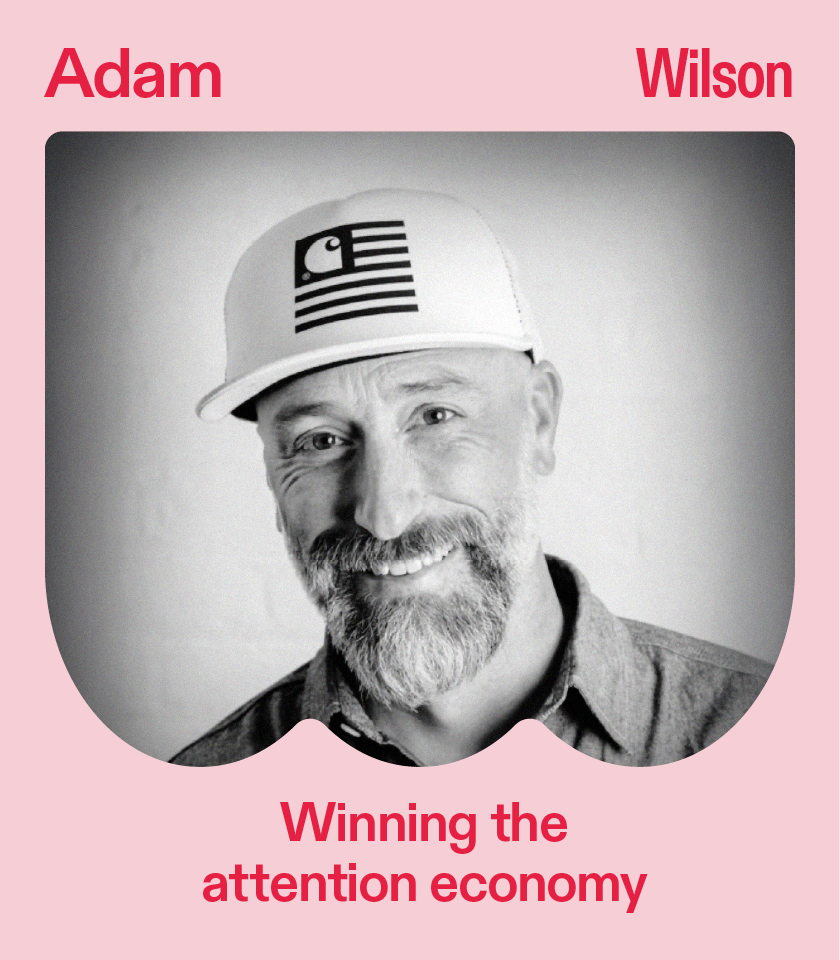
Before co-founding D/CAL, Adam Wilson spent nearly three decades inside creative and digital agencies, leading work for brands like Jeep, Disney, and Kraft. He also spent time in-house leading brand marketing at Carhartt, an experience that gave him a sharper appreciation for what CMOs are actually up against.
Today, at D/CAL, Adam helps brands find more potent, culturally relevant insights by looking beyond broad demographics and into the subcultures, passions, and communities that shape how people actually think.
On this episode of Question Everything, Adam explains why differentiated insights rarely come from bigger datasets, why brands need to start thinking more like creators, and why the best agency partners are the ones willing to challenge the brief.
CMOs are under enormous pressure to have the answers. They’re expected to drive growth, build brand, deliver quarterly performance, justify spend, and somehow turn all of that into creative that breaks through.
And because brands have more consumer data than ever, there’s an assumption that the answer must be somewhere in the dashboard.
Adam thinks that assumption is part of the problem.
When every brand is looking at the same data, using the same tools, and arriving at the same averaged-out picture of the consumer, it becomes much harder to create anything meaningfully different. The numbers may point you in the right direction, but they rarely reveal the nuance that makes an idea feel true.
At D/CAL, Adam and his team are “unapologetically qualitative.” That doesn’t mean ignoring quantitative research. It means using it as a starting point, then going deeper.
For one Scotts project, the team started like many others do, with audience segmentation, social listening, and AI-assisted research. But the real unlock came from talking to people inside specific subcultures and interest communities. Through those conversations, they discovered that some consumers didn’t talk about their “lawn.” They talked about their “yard.” That subtle language shift revealed a bigger mindset: these people weren’t trying to create a perfect patch of grass. They wanted an outdoor space their kids, pets, and families could actually use.
That kind of insight doesn’t usually show up cleanly in a spreadsheet. But it can change the work.
The lesson: Don’t let data give you an average insight for an average campaign. Use quantitative research to find the neighborhood, then go talk to real people. The differentiation usually lives in the nuance.
Brands often expect creative to do all the work of differentiation. Adam argues that’s asking too much, too late.
By the time an agency gets to concepting, the team shouldn’t still be trying to figure out what makes the brand different. That point of view should already exist in the strategy and the brief.
In Adam’s view, strategy is the “what”: what needs to be said or demonstrated to a particular audience. Creative is the “how”: how to bring that idea to life in a way people will notice, remember, and care about.
The best gift a CMO can give an agency is clarity in the brief. Not a 30-slide deck that tries to sound strategic. Not a pile of disconnected inputs. Real conviction.
If a brand can clearly explain what it needs to say, creative teams have more freedom. They can stop trying to decipher the problem and start exploring the many possible ways to express the idea.
As Adam put it, a strong brief gives creatives room to bring back a “rainbow of ways” to say or demonstrate the thing the brand believes.
The lesson: Don’t ask creative to manufacture differentiation from scratch. Pull differentiation upstream into the insight, strategy, product, positioning, and brief. The sharper the “what,” the stronger the “how.”
D/CAL's advisory board includes Tony Hawk, producer Paul Blair, wellness entrepreneur Jessica Murnane, sneaker culture figure Rick Williams, and other outside voices who don’t come from traditional agency backgrounds.
That’s intentional.
Adam believes agencies are no longer just helping brands compete with other brands. They’re helping brands compete with creators.
Creators have become some of the biggest winners in the attention economy. They understand how to earn time, build trust, shape culture, and keep people coming back. Brands, meanwhile, are often still asking how to beat the category competitor.
That may be the wrong question.
The better question is: would someone actually choose to spend time with your content?
D/CAL's advisory board helps pressure-test ideas through that creator lens They help the agency see where a brand idea feels alive, where it feels forced, and where it needs more relevance before it enters the world.
The lesson: Your audience doesn’t separate branded content from creator content. It all competes for the same attention. If your work doesn’t earn someone’s time, it probably won’t earn their loyalty either.
One of the clearest signs an agency cares? They’re willing to challenge the diagnosis.
Adam sees brands come to agencies asking for a “new paint job” when the real problem is with the plumbing. In other words, they want a campaign to solve a deeper issue in positioning, product, business strategy, or audience understanding.
A weaker agency may take the assignment, answer the brief, and hope the work performs.
A stronger agency will pause and ask whether everyone is solving the right problem.
Honesty can be uncomfortable. It may mean rethinking the brief, questioning assumptions, or telling a prospective client something they don’t want to hear. But Adam argues that’s where an agency’s real value shows up: in its ability to diagnose, align, and push toward the problem that actually needs solving.
The lesson: Don’t mistake agreement for partnership. The agencies that care most about your business are often the ones willing to challenge your thinking.
To hear the full conversation with Adam Wilson, including his take on AI in strategy and what CMOs and creatives misunderstand about each other, watch the full episode on YouTube.
Part interview, part therapy, part Price Is Right, the Question Everything podcast puts your favorite CMOs and marketing leaders in the hot seat. While they face off against our game board, you’ll learn from the wins, mistakes, and hard-earned lessons of the best in the business, all daring enough to be curious.