.png)
I’m a huge fan of Japanese culture, namely sushi and anime. As I get older, the amount of time I can go without either keeps shrinking, and there’s a reason why.
In this quick-meal and short-attention-span economy, both sushi and anime trend and endure for a simple reason: they require mastery.
In Mastery, Robert Greene uses a word that gets close to what Japanese artisans have spent generations embodying. Greene uses the word prehendere, roughly translated from Latin as “to grasp with one’s hand.” His larger argument is that to truly understand one’s craft, career, or in this case, industry, you have to spend decades tirelessly working by hand to make something your own.
So when I think of how I started my social media career designing Myspace pages for friends during the summer after my sophomore year of high school in 2008, I imagine how many more decades I’ll have to work in order to approach the level of mastery that Hayao Miyazaki has.
Over more than half a century, Miyazaki’s studio, Studio Ghibli, has built a visual language through countless hand-drawn frames and become one of the defining forces in anime feature films. In 2003, Spirited Away won the Academy Award for Best Animated Feature, making Miyazaki the first Japanese director to win that award.
Fast forward two decades, and Studio Ghibli’s visual language is now one of the most popular, and poorly, imitated illustration styles, replicated with only a few taps inside your ChatGPT app.
That controversy has fed what many online now call AI slop, but it also points to a much bigger conversation: where audience appetite, AI, and the social algorithm have started to split in 2026, and what brands need to understand if they want to cut through an era where people are more overstimulated than walking across Shibuya Crossing during cherry blossom season.

The first thing we need to acknowledge is that our audiences have crossed the chasm of social media into the point of no return.
The good news? After nearly a decade of social media managers building recap and pitch decks around why they need more support, CMOs finally got the message: social-first is the new black.
The not-so-good news? The speed of social has outpaced last year’s social playbook by a long shot. Posting frequently to build a brand’s social presence became non-negotiable in 2016. In 2026, social-first approaches are still essential, but they are only the tip of the iceberg.
As Gary V. aptly put it, we are no longer in a Social Media era. We have entered the “Interest Media era”.
Social Media valued followers, likes, and monolithic-like cultural conversations. TikTok disrupted that at the turn of the new decade, when teenagers could go mega-viral in their parents’ backyards with one post.
Today, in Interest Media, your audience’s attention span has become the metric of success.
Interest Media now values share volume, watch time, replay value, and what Head of Instagram Adam Mosseri says matters most: “reach and stability of reach.” This became clearer than ever on December 10 of last year, when Mosseri launched “Your Algorithm” across Instagram and Threads, giving audiences worldwide the ability to prioritize what appears at the top of their feeds based on their own-entered topics (read: interests).
That’s how Airlearn is beginning to steal massive attention share from Duolingo. Through wildly provocative, hook-first social strategies, they grew their social page’s following from 5K to 430K and amassed over 50M organic views in less than seven months.
They understood that thumb-stopping is no longer the goal.
Thumb-sharing is.
When I think of up-and-coming brands that understand interest-first social strategy, I think of the Arran Studios clothing brand.
About a month ago, I came across one of their ads in my feed. It hooked me, but then it did more than that.
The three-second, social-first VO hook was: “I love combining two things that don’t go together,” overlaid on aesthetically pleasing yet almost ordinary wool-colored trousers.
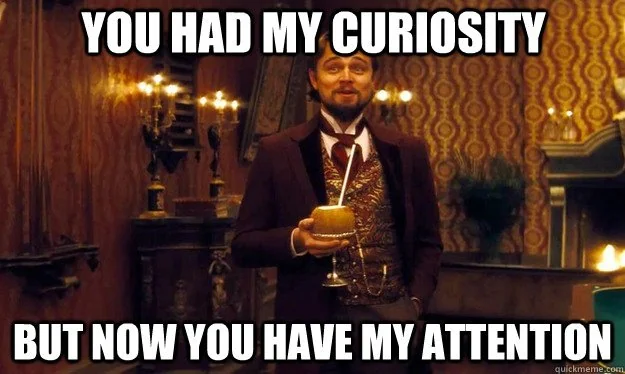
“Okay, you’ve got my curiosity.”
Then Arran Studios’ reel shifted to a story-first social narrative, overlaying vintage photos of 1950s NASCAR pit crew uniforms before cutting to 1938-era sartorial print ads. They kept pulling me in with iPhone BTS, a MacBook showing 3D mockups, and early sketches of the trousers.
Finally, they crystallized my need for the trousers by showing close-ups of the product features.
All in less than 60 seconds.
“Now you’ve got my attention.”
When I clicked the “ shop now” sticker, the pants were sold out. Apparently, I wasn’t the only one pulled into the ad.
So naturally I didn’t follow, but I kept getting more social-first ads for other products they had. Each ad was a different styled photo or reel that pulled me deeper into their handcrafted world. Both their products and their content felt like mastery in the palm of my hand.
For weeks, I didn’t follow them. Like most millennials, I like to keep my follower-to-following ratio decent. But I kept returning to their page, growing more fascinated each time, until I finally purchased a shirt and a matching hat.
It was only after the purchase that I followed them to learn more, including their SS26 drop, which is happening in early June.
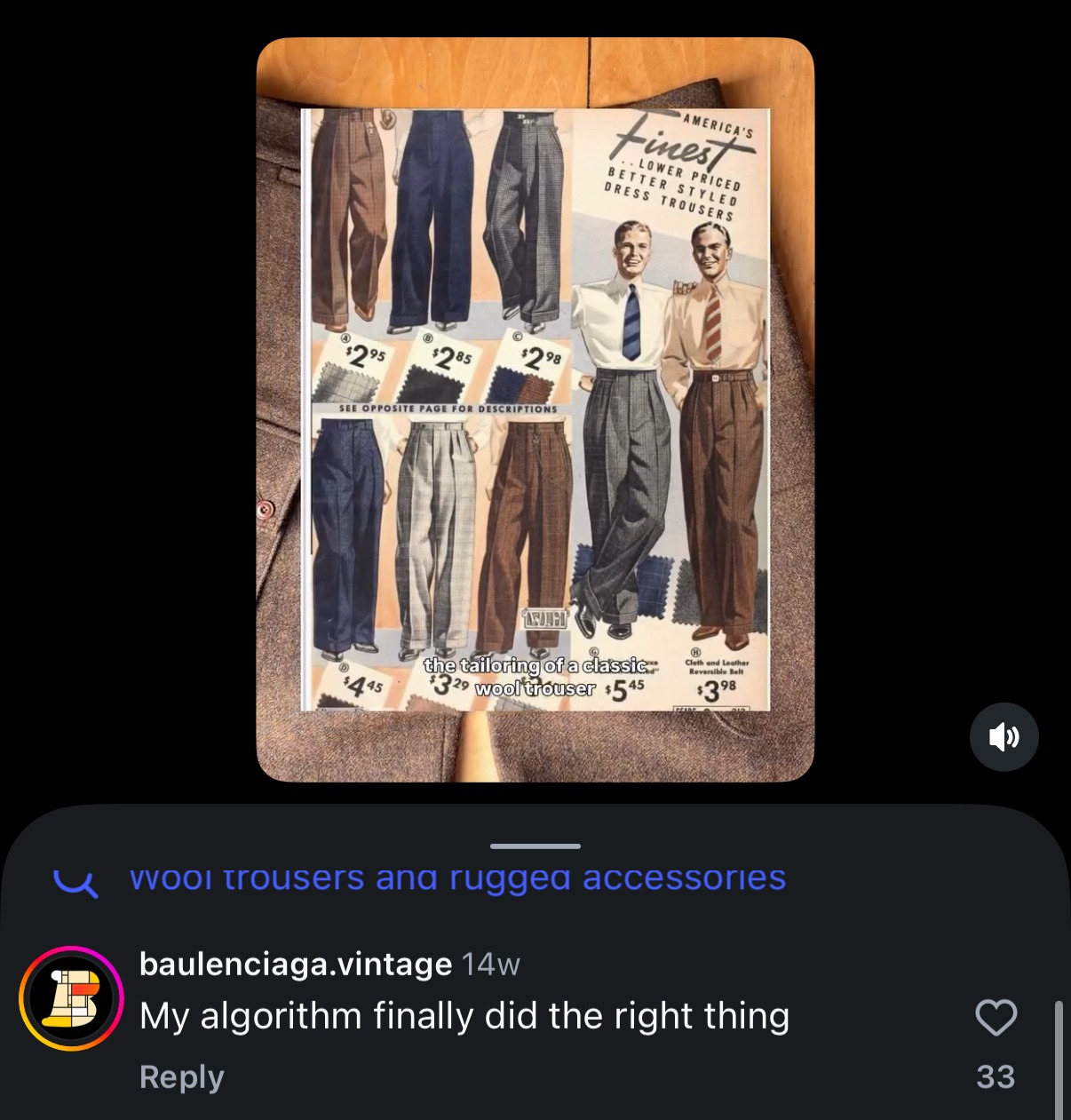
That’s what happens when you ladder down story-first social strategy with an optimized hook-first tactic.
You don’t gain a follower.
You gain a fan before the product even reaches their doorstep.
So the short answer is no: social-first is not dead.
It’s just not enough anymore.


.png)