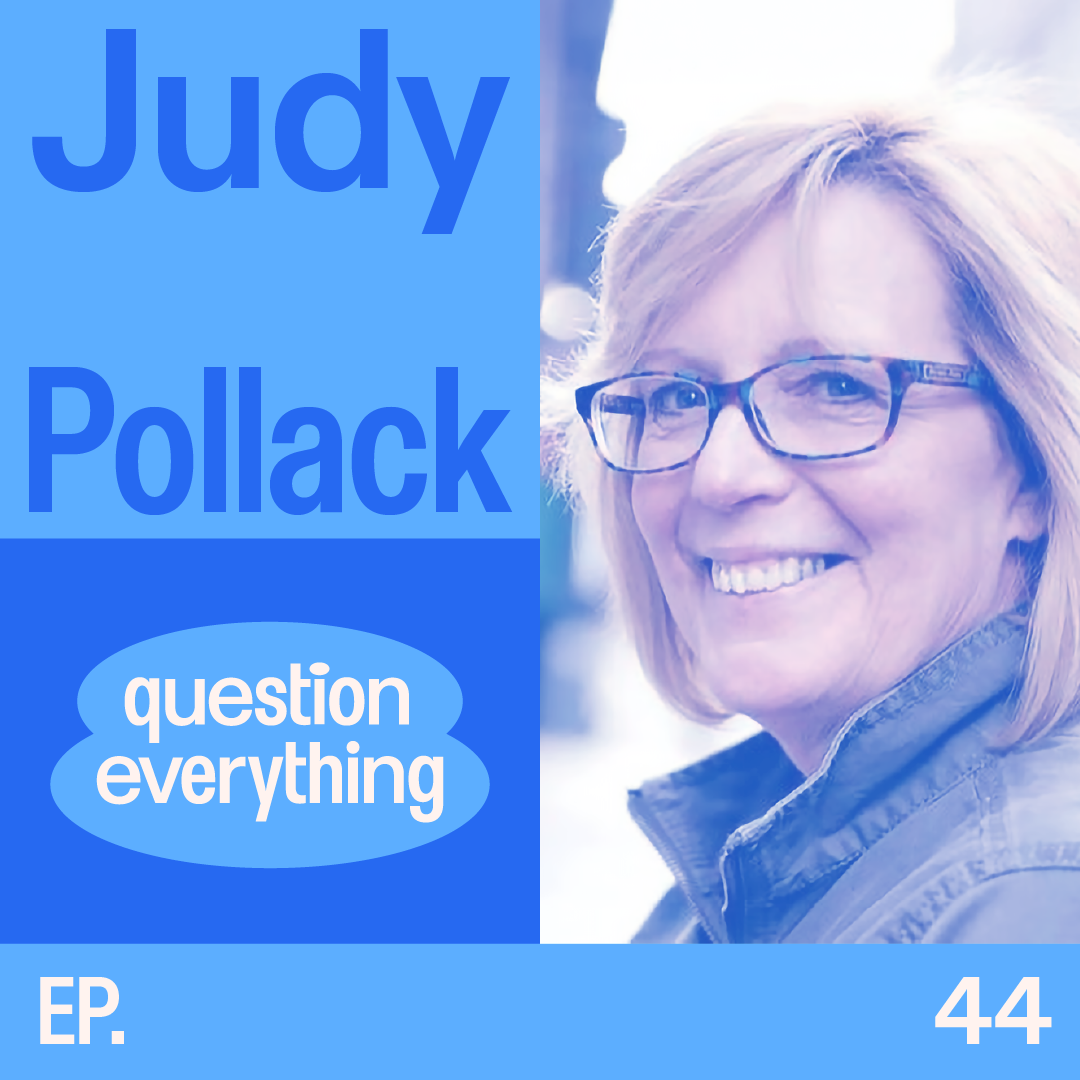
Judy Pollack has had a front-row seat to advertising for nearly 40 years. Since joining Ad Age as an editorial assistant in 1985, she has held nearly every position on the masthead, including reporter, Chicago bureau chief, New York bureau chief, features editor, and managing editor-international. Today, as Executive Editor, she helps shape the industry’s biggest conversations while leading Ad Age’s A-list and Small Agency Conference & Awards.






As Ad Age’s Executive Editor, Judy Pollack has her finger on the pulse of the biggest campaigns across the marketing industry. In addition to breaking major industry news, she also helps determine which shops deserve a spot on Ad Age’s coveted A-List and Small Agency Awards.
In this episode of Question Everything, we got the scoop on why small indie agencies are gaining ground, how they’re earning the attention of major brands, and what helps the best shops stand out in an increasingly crowded landscape.
Subscribe to Ad Age for the latest marketing news
Hello, everyone. Welcome to Question Everything, a podcast all about learning from the successes and the failures of those who dared to, well, question everything. This podcast is part interview, part therapy, and part Price is Right. We have our own game board stacked with questions that'll make even the most successful CMO sweat. I'm your host, Ashley Wolter, CMO and partner at CMO. curiosity. Today I'm sitting down with Judy Pollack, executive editor at AdAge and one of the most trusted voices in advertising journalism. Together we revisit some of advertising's most jaw-dropping moments since the 80s and unpack what brands and agencies need to do to earn attention in 2026. In this episode you'll hear the fastest way to get on AdAge's radar, how Judy broke one of the biggest stories in advertising history, the small agency superpower that's making Holdco's nerds us, the most Mad Men story Judy can tell us without getting in trouble, and a special appearance from an American Idol winner. So grab a payphone and shout, hold the press. This episode is front page worthy. Let's get started.
Subscribe to Ad Age for the latest marketing news
Judy Pollack has had a front row seat to advertising for nearly 40 years. As Ad Age's Executive Editor, she's helped shape some of the industry's biggest conversations. While holding just about every editorial role along the way. Besides running a tight newsroom, Judy leads AdAge's small agency conference and awards, which is widely considered one of the industry's best events, especially to small indie shops like ours. Judy, welcome to the show. Well done, Ashley. Thank you so much for having me. Absolutely. I am so excited you're here. I feel like this is a long time in the making. I was just with you in LA at the Small Agency Conference and Awards. You must still be on a high. I think I'm still on a high. LinkedIn is still talking about it.
It is absolutely my favorite show of the year because it celebrates the best, the newest, the hardworking small shops that are out there. I would love to hear from you, like any big takeaways or, you know, anything that you can share from your experience this year. Yeah, the best thing about it, of course, I'm biased, right? But I think the best thing about it is the ability for people to network and to learn from one another. And this year, for the first time, we had breakout sessions among the members of our small agency network. I think that was really well received. I just feel like the energy is always off the charts at this thing. And it's just such a labor of love to put together.
I mean, I'm exhausted right now, but I'm so happy that another one came off okay. Yeah, well, on behalf of all of us small shops. Thank you for recognizing us. Thank you for giving us a platform. I can tell you personally, from my perspective, owning a small agency, it has changed so much for us and the trajectory of our agency. So a lot of gratitude to you in particular, but the whole at-age crew for just being such big supporters of this community. It's really a labor of love. Honestly. I mean, it's such a great community. The people are so awesome. It's so much fun to deal with you guys. So I'm really glad to help you all along in any small way. I love it. I led one of those breakout sessions.
in the morning on day one and I told everybody that walked in I'm like all right everyone in here has to sign an NDA first because it's going to get real and that's probably one of my favorite things about small agencies is how open and willing everyone is to share and help each other And no joke, I'm like, I'm was I'm literally in a pitch with two of the agencies in the room. And yet we're still sharing and trying to help each other. And that's pretty special, I think. I agree. Yeah. All right, my friend. Well, you know how this show works. I cannot wait to get to know you even more through this podcast. I have 12 super spicy questions that we might be sorry. Okay, no way. No way.
Subscribe to Ad Age for the latest marketing news
I'm excited. And you know, the power is in your hands. So you don't know what's behind these numbers. I don't know what's behind these numbers. So let's just see what happens here. They always say the last is best, right? So let's go with 12. Okay, let's go straight to 12. Oh, I have a special guest for you. Here's a Hey, Judy. My name's Dave. Hi. I have a question. What's the most Mad Men story you can tell without getting in trouble? I have another question. What's your go-to karaoke song, and why is it me? All right. I'm told you're a huge fan of David Cook. Yes, yes, I am. For those of you who don't know who he is, he won American Idol in 2008, I guess it was, 78.
And I just love his music. And I've been following him for almost 18 years now. I've gone to so many concerts; I can't even tell you how many. So that was really special. Thank you. You're so welcome. So David wants to know: what's the most Mad Men story you can tell us? Well, you know, like I've been there 40 years, but like the real Mad Men stuff was like the 60s, you know, 70s. So I kind of missed, you know, the free love, sex kind of thing. But at least in terms of in the 80s, as a reporter, in fact, I did a Substack about this: what it was like to be a reporter in the 80s and 90s covering advertising. And it was like three martini lunches were a thing.
I never drank martinis. I drank wine. But they were a thing. And, you know, I got to go to Martha Stewart's home in the Hamptons for a press conference. There was a press conference for a frozen dinner. I kid you not. They sent us to Redding, Pennsylvania for a murder mystery overnight stay. And that's a press conference, right? Oh, wow. Yeah. It was just crazy. But, you know, you worked in little cubicles with a lot of cigarette smoke, and you squinted a lot. And if you got a tip, you had to run to a pay phone to call it in. Everybody went to Michael's for lunch, which I still guess a hot spot, but you'd be sitting there, and Tina Turner would be at the next table, you know?
So it was, it was pretty exciting time to be a reporter, but I haven't, I didn't, there wasn't a lot of hanky-panky that I know of, although I've heard some stories that I couldn't verify. All right. And your favorite karaoke song? Oh, gosh, it's actually not any of David's because they're way too hard to sing. He has a beautiful voice, and I have no range whatsoever. My husband used to say that I couldn't carry a tune in his suitcase. So if I have to do a karaoke song, it's usually Girls Just Want to Have Fun. Oh, that's a good one. Okay. All right. I like that. I'm curious about your lunches back then versus your lunches now. What is a typical lunch look like for you now?
Mostly at my desk or kitchen where I am right now. So gobbling stuff in between. But we still, you know, we have fun. We go to dinners. You and I have been to dinner. You know, it's so fun to catch up with some of the agencies and just find out what's going on with them. But it's a little less lavish than it used to be. We didn't all go to; at the time, it was Tavern on the Green or the Pool Room at the Four Seasons. That's right. That's right. Yeah, it is interesting to think, yeah, most of my lunches these days are spent kind of at my desk. But going back to small, I feel like some of my favorite moments were these like.
Small, intimate lunches that you just sat with a couple of folks that you don't get to see very often and catch up and share stories. And I do like it when we can get out, but we're not getting out nearly as much as they used to back in the day, I suppose. Yeah. A lot more work going on. Yeah. Maybe we're working harder. I think so. All right, let's go back to the game board. I don't know if I'm going to top that one. How's two? I don't think we're going to top that one, honestly. All right, let's look. I'm going to see him tonight. You are? Yeah, I'm going to the concert tonight. Oh, my gosh. Well, you'll have to tell him that you got his question.
Subscribe to Ad Age for the latest marketing news
All right, what's a story that Ad Age missed or misunderstood or maybe didn't see coming fast enough? Well, you know, it isn't exactly missed, but we miscalculated. Let's put it this way. Way back in the early days of the internet, we did have a website, but we weren't really breaking news on the website. Like we still thought of that as an adjunct, right? If it were to be a really breaking news story, it should be on the cover of the Monday issue. So we knew that Grey Advertising was going to be bought by WPP. And we were like, oh, this is, I think, 2005. And we're like, oh, we're going to hold this. It's too big. We're going to put it on Monday.
And of course, that was a real miscalculation because the New York Times- Phil Doherty at the time was a New York Times correspondent. And he had a Saturday paper. So he broke the news ahead of us. And that was the last time we ever, ever, ever tried to hold anything. So that one was. You know, when about missing, you know, that was one. But in terms of didn't see coming, there's just like a lot of things that you don't expect, obviously, like, when Martin Sorrell left WPP, I remember I got a text while I was sitting in a restaurant about to finish my meal and going to see Pretty Woman on Broadway. So I had to leave, go home, and start working on the story. The same thing happened with, sadly, when Dan Wyden died.
I remember I was in a Home Depot, and I had to abandon my cart and run home, start calling reporters on a Saturday and say, Can you help me write this? So, yeah. So fascinating. So when you do get a hot news tip, let's say something scandalous is going down or really interesting, how many verified sources do you have to have before you feel like you can run it now that we know time is of the essence? Yeah. Well, the ideal is at least three. Three. Okay. Sometimes if we know for a fact, we know this person, we know it's somebody who's really directly involved. In this situation, it's definitely in a position to know we'll go lower. Okay. But for the most part, you know, the great thing is three.
Subscribe to Ad Age for the latest marketing news
Okay. The idea. All right. All right. Let's go back to the game board. Okay. 10. Number 10. All right. We actually talked quite a bit about this at one of my lunches at a small. So Super Bowl still gets the budget. You know, TV is still getting the budget, but social is driving the brief.And I'm hearing a lot of agencies say that a lot of the RFPs that are coming out, a lot of the client briefs that are coming out says social first campaign thinking. So my question back to you is, what do you think that says about the state of our industry? Well, actually, social goes backwards to the Super Bowl, right? You start, you do the Super Bowl, but that's just the beginning of everything.
That's where you really need to seed your social with whatever game shows or whatever you're doing with it. I know you guys did Peeps, right? Yeah. You know, outside the Super Bowl. So I do think that. Social is really where the pulse of the industry is right now. Everybody's on that in one form or another. And it's all about creating one-to-one connections. And nothing could be less one-to-one than the Super Bowl, right? It's mass media, right? Whereas if you can create a connection through social, which is what I think came through in our awards this year, some of the winning agencies, the big winning agency was a social agency. I do think that, yeah, we have to really think more personal and one-to-one, however that plays out.
Yeah, that's great. Do you think we're going to start seeing budgets start going more towards social? Because I mean, it's true, like the mass budgets are still living in these like TV, video heavy kind of segments in the media plan. Well, by its nature, social is a little less expensive for marketers. So I think that's another reason why they like it. Yeah. But I think they're starting to recognize that there's more value in it. And it's not just any more, well, we'll just put up a post that has to do with, you know, whatever, mittens at the Super Bowl or something like that, or Oreo. You know, it's really that you have to be on it all the time. Learn your brand's ethos, and carry it through everything in social.
So I think there's going to be more different specialties within social; we already have some, you know, some that focus on entertainment, or athletes and things like that. Or so I do think that budgets are going to go up, especially if you can prove the value in what you're doing. Is more important than just saying, okay, I'm going to throw up a quick tweet or X, whatever you call it these days. From a publication standpoint, do you guys get as excited about a social campaign that you do with more of a video-heavy or a broadcast campaign? I don't think the medium matters. I think the idea matters, right? So if we see something exciting, whether it be in any format, then you're like, oh, okay, this is really something. Yeah.
Subscribe to Ad Age for the latest marketing news
It's smart. So we're kind of agnostic in terms of media. Yeah. Good answer. I like that. All right. Let's go back to the board. We haven't done the middle yet. Let's go for five. Okay. Number five. Okay, so you've experienced the disappearance of legendary agency names. So when a name like J. Walter Thompson or YNR goes away, what's actually lost for the industry? Is it reputation, culture, history, or is it just signage? I know all of the above, honestly.I mean, I do think there are some agencies that are a bunch of initials that are still doing really good work, but this industry was sort of built on personality, right? That's kind of actually something I'm a little bit sad about. Yeah.
You know, there used to be like really cool, you know, we have some, but there were legendary names that you would be like, oh my God, you know, David Ogilvy walked into the room, or you know, Lee Clow or something like that. And that's kind of not happening so much anymore, which is kind of sad. But those people were the creators of this business. So, I mean, I guess it is a little bit backwards thinking because, you know, they are old legacy agencies. But I do think there's something to culture. And that's why the small agencies are doing so well. They have great cultures. And when you get too big to be able to like work with that culture, then I think it's a loss for everyone.
Yeah, I mean, it's definitely hard from my perspective, like sitting back and just reading about all of this, all the change that's happening and the mergers and the acquisitions and the closings. And it does feel like a bit of history and these icons that you've looked up to. It's kind of going away. And those cultures, in a lot of ways, are going away. And it has felt a little like a mourning in some respects from where I'm sitting. Right. I agree. Yeah. And if you're in, like, a giant agency right now. It's, it's a, I don't know, I work for a privately held company where I kind of know everybody, right. And I always did.
And I think that that was sort of a benefit where you could go into, you know, to Rans Crane's office and say, Hey, I have an idea or something, you know, where it doesn't, it isn't that way anymore. Yeah. Yeah. Very true. All right.
Subscribe to Ad Age for the latest marketing news
Let's go back to the board. Um, four. Number four, what do CMOs need to understand about the new wave of super independents? You know, I get from a lot of small agencies that they feel like they're underrepresented in terms of bigger clients and that bigger clients think that they can't handle, you know, as a large account. And I don't think that's necessarily the case. I'm seeing a lot of small agencies do really well with big clients. I mean, you're on the P&G roster, right?
It doesn't get any bigger than that. So, I think that at least from the agency perspective, I haven't talked to a lot. I have talked to some CMOs who have said that they feel like small agencies need to get a better grip on data and some things like that. But I do think that for the most part, you're in the consideration set more than you were before. And the question is, I think some of the bigger clients went in initially thinking, well, they'll work cheaper. And I think that that's kind of changing, you know, but it's up to agencies to really make sure that they prove their value. You know, this is why. We are worth what we're worth. It's hard to do. But I think that the pendulum is changing.
Yeah. So one of the sessions I led at Small this year was about how to leverage your independence to make it more of a value proposition to clients and make it worth something that they should not only care about, but pay for. Because being small or being independent doesn't necessarily mean you're cheaper. And one of the themes coming out of there was just the confidence that exists right now in the small agency community. And I absolutely loved it. I think there was a time when maybe we were afraid, and we're not just like the big guys and what we bring is different, but we have to pretend like we're big and pretend like we're like them. And I think what I heard is, no, we're done pretending.
This is who we are, and this is what we're really great at. I had multiple agency owners tell me, I would much rather compete against a holding company in a pitch than I would another independent. They are far easier to beat. And I thought, OK, like that to me is a signal that there is something really working here and it's being proven out. I mean, just looking at the body of work that was represented at Small this year, really good work is coming out of this community. And I thought that was exciting. Well, in the Keynote, Megan Lally was our keynote this year. She did a whole list of, you know, how many independents were on the A-list versus a few years ago. And it's really true.
I do think there's wind at the back of the independents. But that said, there are so many small agencies that you really need to carve an identity for yourself. Because it can be tough to stand out from the next guy. So I think that's the big challenge everybody's facing right now. Yep. Yep. That's really good advice. I think positioning. Yeah, is really important. We can all start to sound like the same, huh? You would know you got you guys get all the pitches. All right, let's go back to the board.
Subscribe to Ad Age for the latest marketing news
Seven okay you've been with Ad Age since 1985 what's the most important industry story you would say that you've had a front row seat to well this one's pretty easy um it was the big bang which was the um the merger of Needham Harper Steers at the time and DDP and BBDO.
And I had just pretty much started with Ad Age, and I was sharing a cubicle with a reporter, Stuart Alter, who was an amazing reporter. He was one of the best reporters I've ever known. And I would learn so much just listening to him on the phone. Right. And so he was there one night. And again, we weren't print-only, and so we were trying to decide if we could break this story to the three agencies. And we held the presses, which we've never done. That literally happens. And we're trying to figure out what to do. And there was a conference where we went into the bureau chief's office to try and figure out what to do. And I'm sitting in the cubicle and the phone rings. It's Stuart's phone.
And I picked it up. And it was the Deep Throat source who told him what the third agency was. So I always said if I was in the bathroom or something, we would never have broken that story. Wow. I'm chill. That's really cool. That's really cool. So you get the phone call, and then like, what happens? You run in there? I run in, and I'm like, Stuart, Stuart. And he came in. And then, you know, we had it for sure. And we started writing. So it could be exciting. Breaking news can be super fun, you know. And then the other one I might say was, it was the failed merger of Publicis and Omnicom a few years ago, right? And when it fell through, we were just trying to figure out what to do.
Like, like, how do we address this? What are we going to say? Yeah. What are we going to say? And so we ended up waiting until the last minute, try and find a cover. And I was talking to the editor at the time. And I'm like, why don't we just take the two words, nevermind, and put it on the cover. And that's what we did. It was a fully black cover with never mind in little letters in the middle. And it was so funny because Jerry De La Femina had been in the office that day to do a video with me. And I showed him the cover, and he said, you should be in advertising. I am. I know. Wow, I love that. Do you have it at your house still?
Do you have it, like, framed? Actually, when we had our anniversary, we had little playing cards made of different covers, and that was one of them, yeah, that we handed out. Oh, I love that. That's incredible, Judy. Oh, my gosh. Like, what a- Yeah, it was, that was really something. But we worked all day. We couldn't think of, what could we do? What kind of cover? We had some drawing up that were, just didn't cut it, you know? And we thought, well, that's the best way to do it, so. Yeah, it's better than whoops. Yeah, right? Awesome.
Subscribe to Ad Age for the latest marketing news
All right, let's go back to the board. Oh, lucky number one. Okay. What makes you think I need to keep an eye on this shop? Is it their work, reputation, momentum, just really adorable owners?
Who are the adorable owners? I think, well, our discovery comes, believe it or not, a lot from the small agency awards, right? And I always say to people, even if you don't think you have any chance of winning, I really think you should enter. And it has nothing to do with, you know, finances or anything like that. We look through these, and we go, wow, you know, I've never heard of this agency before. They're doing super, like really awesome work. So I think it's discovery through the awards. Actually, Conscious Minds have won this year. I had never really heard of them before. And they won the whole thing. So I do think that that's a means for discovery. We also hear buzz in the market, right? People are saying, oh, did you see that campaign?
You know, Tim has a lot, Tim Nudd, who does creativity. He gets all these cool campaigns all the time. And we look at them and go, wow, you know, this is somebody maybe we need to have on our radar. Also, if somebody is really winning a lot of new business or something, I'm like, oh, ok, something's happening here. Let's keep looking. Or if there's a really major hire, like, why did that person go there? You know, that's an agency we've never really heard of. And they have a great big job somewhere else, and they're leaving, you know. There's a lot of things we look at, you know; we just try and keep our ear to the ground as much as possible. That's good advice for agencies.
I know, at least for me, at the last two agencies I've worked at, I've always said it's a five-year plan. You have to keep entering, and it doesn't matter that we're not going to win. You've got to get in front of them. They need to hear our story. And you're almost like writing your next year submission now, you know, like you can't wait until it's due. So I do. I'm actually really glad to hear you say that because no one's really ever validated that for me. I've just always said that was my theory. I'm like, that's got to be kind of right. So I do appreciate that. Even if they don't win or whatever, we'll see things in the entry where this point of view is really interesting.
The next time we're doing a story on talent, say. Why don't we call that person? They had some really interesting things they said in their entry. So we also use it as sort of a way to find new sources for other stories. What really stood out for you with Conscious Minds? What made them the big winner? I think it was just their approach to social was so immersive. They really understood what Starbucks meant to consumers and really showed it in their work- how that manifested, whether it be through barista contests and little bear drinks and, you know, the intern jacket. I was joking to the president that he should have worn the intern jacket to the award show, which I thought would have been cute. But I just think it was so many things.
And I'll be honest with you, I'm not really a Starbucks drinker. But I just, you know, I just thought it was really super creative. And they've been around 18 years, and they've been just doing this work toiling away in the dark. Uh, so I think all of those things really appeal to all the judges. Awesome. Well, congratulations to them. That's really great.
Subscribe to Ad Age for the latest marketing news
All right, let's go back to the board. Six. All right. Number six. Well, you kind of just talked about this, but Megan, um, you know, in her keynote said half of this year's A-list winners were independents. look back a decade that was not the case as you know so my question to you is are indies really winning right now or are the you know are the holding companies just becoming easier to beat well there's certain ways you're never going to be in a holding company if you're Or if it's something that's a massive media spend where, you know, all the clout is going to really matter, right?
But in terms of just getting the attention of those major companies, I think that small agencies and independents in general, obviously, are really doing better. And now that a lot of, at least our small agencies, are partnering with one another. Yeah. That's another cool thing that's been happening from the network, right? You know, you need a media partner, you need a social partner, you need a commerce partner, whatever. We've got one for you. We have a directory now where you can actually find other people to work with, which I think- and I don't mean to keep plugging the network, although I do in a way. No, I mean, we do partner. I mean, the phrase I don't know if you coined this or if somebody coined the super independents- but it's these independents coming together.
And, you know, you've got the case of, like a Barclay OKRP where it's very formal, and it's a thing. But then you also in some ways have these indies that are coming together for maybe a moment in time or a longer period, but they're forming this alliance, whether it's for a project or all projects. I think that's really cool and unique, and we haven't seen a lot of that. Yeah, the collabs, I think, there's so much creativity in how small agencies are approaching it, right? There are little independent networks. There are people who are turned into PE, but they're taking minority stakes. Those are the majority stakes. They're finding different partners to work with in different ways. It's just... really, there's just so much creativity.
And it's not just coming out in the work; it's coming out in how you are marketing your own agency. Yeah. Why should the holding companies be afraid of the indies? Well, I think the one thing they can't do at this point is give personalized service, right? John Wren is not necessarily going to call and talk to you about your account. I mean, maybe if, you know, you're a Segundo multinational. Right. But, you know, I think you're getting a lot of personal service at the small agencies that they just can't do right now. And as a matter of fact, we uncovered a trend of some of the CEOs actually renaming themselves as chief client officers. Right. Because it's all about the client, right? Yeah. And if you've got 100,000 whatever clients, you know, that's tougher to do, right?
So I think the small agencies definitely have a leg up in terms of client service and what they can offer in that way. Yep. Sir John Haggerty at Cannes said something very similar, like the title of CEO as we know it is dead. And he offered a variety of different titles the CEO could take. So I like that suggestion as well. It's interesting. I sat next to John in Cannes one year and it was just so, I was fangirling, you know, because like BBH, you know, again, those legends they don't exist anymore really so much I was the same way this I mean I was in the audience of thousands but i was i felt like he was talking right to me it was um it was a really incredible presentation no filter and his slides are so well done like i was like taking pictures of all of them just oh simple and memorable all right let's go back to the board
Subscribe to Ad Age for the latest marketing news
Nine eight nine all right let's go number nine after interviewing hundreds of cmos what would you say the best ones have in common well i come at it from a journalist's perspective the best ones to me are the ones that are honest we don't talk a little a lot of marketing speak who will tell me really what they're thinking as opposed to being you know um media trained to death by the PR department. So that is one thing I like about, you know, if you, and there are some, you get some really cool CMOs you talk to, and they'll just tell it like it is. But I also understand why a lot of them don't do that. I don't know.
I talk to agencies more than I talk to CMOs because that's EJ Schultz's department for the most part, and his But I think, you know, the smart ones are just really open to new ideas. They're really doing their own thing or not. And this is a little bit of a threat to agencies. They're doing their own thing before waiting for you to do it. Right. They are already very savvy in how they're using AI and all kinds of tools. Those people know their businesses super well. So I think that's another thing that CMOs are really good at right now. Absolutely. It's definitely something we all have to have our eye on and try and stay ahead of, and find the balance between what they know and are really good at and then what we can then bring and supplement and help them, because there are areas where they're not.
We really found some nice kind of pivotal points where we can intersect that CMO in that way and support them, but still let them do what they're really good at, which can be complicated because every CMO kind of has a different M.O. They've got a different need. They're in the business for a different reason. So you've got to kind of figure out their why and what their specialty is. But it makes it fun. Yeah. All right, let's go back to the game board. Oh, eight. All right, let's go number eight. So you've covered the industry through digital, social, and now AI.
Subscribe to Ad Age for the latest marketing news
Which era created the biggest shift in marketing, and which one created the most hype? I mean, digital has got to be the biggest shift, right?
I mean, because it's the root of everything else that you talked about, right? But I remember even starting out, I guess I was working with Ed Age International, which is a short-lived publication that I was managing editor of. I can't even tell you, but it went back to 1990 or some odd. And we would get stories in like, you know, from our Tokyo correspondent who would have all the WWW stuff. And we're like, what's this WWW? I mean, yes. But I mean, we jumped on it like really quickly. I mean, we were the first to have an- we called it the interactive age or something like that. Well, we were covering that, you know, I honestly think we've been ahead of the curve on a lot of this stuff.
So I'm proud of that. Not me personally, obviously, but I do think that we've done a pretty good job of that. So I think digital, but now everything's digital, right? So it's really hard to separate. I do think the biggest hype right now is AI. You know, that's all we're going to hear about for quite some time. Yeah. And people are doing some really cool stuff with it. And I hate to sound like all those people saying, " But you need humanity, you know, but that's kind of what we've been hearing all the time. I do think we're using it a lot at age two, you know, we're using tons of AI. So it's just going to evolve. And after that, there'll be something else. Maybe it's robots. I don't know.
I have to ask, since you read, how many submissions were there in small? I'm going to guess. Yeah, we're not supposed to actually say. But yes, it's in the hundreds. Yes. It's in the hundreds. It's in the hundreds. And you and your team have to read them all. Yes, we do. Can you tell the agencies that used AI? I'm sure there were some agencies that used AI. Well, we now have a box at the bottom that says, tell us if you used AI for this entry. So we can tell that way. Okay. But not always. I got to tell you the truth. There were some really good ones that I talked to like the PR people afterwards, who did them. And they said, Oh, yeah, we didn't use AI for that.
So, and there's always some really awful ones. A human definitely did. Yeah, some of them people try to be too clever. I love clever; it could be cute, you know, but some of them just try, you know, really too hard. So yeah. All right. All right. That's funny. All right. Let's go back to the board. Okay.
Subscribe to Ad Age for the latest marketing news
Where do you want to go? 11. All right. I love this question personally, because I feel this a lot. So why should a client let their agency pitch ad age? What's the upside for the brand, not just the agency? Well, I think for their own personal brands, it's good, right? Because when we... write a story about a winning campaign or whatever, we try and interview the CMO as much as possible, right?
So for your personal brand, I think that's good. I think for the brand, it's also showing, I mean, your audience is also your CEO, your CFO, right? So you're showing them that you're making smart decisions on who you're working with, and you're showing them that the work is worth reporting that Ad Age is giving you authority on it, right? We're not going to write about just any campaign. We're going to write about the ones that we think are doing well. So that would also be sort of a way to tell your internal audience that, you know, you made the mark, right? So, and I just think in general, you know, I think that a lot of people go, oh, the trades, the trades, but I, yeah, okay, sure.
You want to reach consumers, and you, and you, you'd like the times in the journal, but I think honestly, the trades are really a place to be. And I guess I'm definitely prejudiced in that thing, but I do think that, um, I think we do pretty well in trade journalism. I think we hold our own against the biggies. Absolutely. What would you say to a client that's like, yeah, but we don't want to spill all of our secrets? Well, you don't have to necessarily, right? I mean, I just went through this like I do every year with the small agency awards, right? People will put numbers in there, and they'll be like, oh, but you can't use the numbers. And I'm like, well, that doesn't work, right?
I can't publish a story saying Curiosity won this award, but we can't tell you why. I mean, that is not washed. But I do think there are ways to tell your story without, like, you know, you can say our sales were up double digits. That's not really necessarily, you know, things like that. And I think the CMOs really can go the same way. I mean, we can ask, doesn't mean you have to answer it all, right? And there are ways to answer it in ways that don't compromise with whatever they think they want to hide, you know? And I do think, I think we were pretty fair in our treatment of, you know, people, and we're very honest and straightforward. So... I don't know.
I just think that you don't have to tell the whole world everything, but it would be really great to at least give some thinking and thoughts behind what it is that you're doing, why you're working with that agency, why the strategy was out there, because we're going to ask other people, you know, how they interpret it as well. Oh, great advice. We'll just bottle it up and package it for all agencies to share with their clients. I love that. All right, my friend, this has been so fun, but I want to get to know you even a little bit more. We have a fun game that we play at the end of each show called this or that.
Subscribe to Ad Age for the latest marketing news
You just answer the the first one that comes to mind does that sound good yeah all right here we go i think you're gonna like these well i'm starting with i'm starting with a hard one all right the bachelor or survivor i'm gonna go survivor survivor the new season's gonna startme too all right a list or small agency agency list um it's it's just more discovery um but i do love a-list i work on that too so they're both fun yep very good answer a rescue or a purebred nothing against purebreds but i have two rescue dogs and my husband did rescue dog work and i you know i love them and they're making noise behind me right now as i speak i love it all right cops are firefighters that's easy ah my son's a cop although my husband's a cannon fighter at least volunteer so i love them both all right breakout year or comeback year They're like comebacks, you know, they're good stories, right?
So yeah, it's so much more fun to write a comeback story. Okay. All right. Oh, last one. Brian or Ewan? Well, let's see. I love them both, man. Like, you know, the, I don't know, everybody knows Brian. He's like the player. of Advertising Town. And Ewan is really coming up closely on his heels. Although it's really hard to get a drink with Ewan because he gets carded all the time. The video of you guys at small was so hilarious. I hope Brian has that hat and those glasses forever. I'm glad you I'm glad you said that because we almost didn't do it. It was my idea. And I had a much longer script, and we had trouble finding people, you know, to help us out with it.
And so we finally just ended up doing it as a Zoom. But they were such good sports. They really were. I just like to do something fun. You know what I mean? So yeah, they were good sports. I think Ewan definitely has a career in acting. He was with Brian and actually acted really well too. I was the worst one on it. But who knew? Yeah. But I think I might be a scriptwriter. I think that might be my future. Clearly. I had a much better script, yeah. Well, I can't wait to see how you translate that into a blossoming career. That's exciting. Yeah, I'll keep my day job after, yeah. Definitely keep your day job. We want you. Judy, this has been an absolute honor and pleasure.
Thank you so much for the time. I'm a huge, huge fan of yours. And I just can't wait for everyone to learn more about you through this show. Oh, I'm excited that you invited me. Thank you so much. It was really nice. You're welcome. What's the best way for our listeners to get ahold of you? You know, I think email actually, I know everybody gets a gazillion emails, but I'm not on LinkedIn as much as I should be, honestly. And there are some people who have my phone, they'll text me sometimes.But honestly, I'm all over email all the time. So sometimes I'll get lost in the sauce. But if you try it again. you'll get me. So. All right. We'll make sure we link to it in the notes. Thank you so much, Judy. Thank you.